 İbrahim Aslan Reşitoğlu
TEKNİK BİLİMLER MESLEK YÜKSEKOKULU MOTORLU ARAÇLAR VE ULAŞTIRMA TEKNOLOJİLERİ BÖLÜMÜ OTOMOTİV TEKNOLOJİSİ PR.
İbrahim Aslan Reşitoğlu
TEKNİK BİLİMLER MESLEK YÜKSEKOKULU MOTORLU ARAÇLAR VE ULAŞTIRMA TEKNOLOJİLERİ BÖLÜMÜ OTOMOTİV TEKNOLOJİSİ PR.
-
Varyant-
-
E-Postaaslanresitoglu@mersin.edu.tr
-
Web Sitesi
-
Durum-
-
Ünvan-
-
YÖK Araştırmacı No14909
-


Enhancing low-temperature ethanol-selective catalytic reduction over Ag/TiO2-cordierite catalysts via cerium addition
Enhancing low-temperature ethanol-selective catalytic reduction
Resitoglu, Ibrahim Aslan
The purpose of this study is to investigate the NOx reduction activity of Ag/TiO2-Cordierite catalysts enhanced with cerium (Ce) under varying operational temperatures and engine loads. The aim is to improve the low-temperature activity of the catalyst in an ethanol-selective catalytic reduction system using real exhaust gases. During the catalyst production process, Ag and Ce were used as active components, TiO2 as the secondary support material, and cordierite as the primary carrier structure material. Catalysts with 1 wt%, 3 wt%, and 5 wt% Ce-doped Ag/TiO2/Cordierite were synthesized using the washcoating method and characterized through X-Ray Diffraction, Brunauer-Emmett-Teller analysis, and Scanning Electron Microscopy (SEM). Performance test results demonstrated that the NOx conversion rates of the Ce-doped catalysts exceeded 90% at 300 degrees C and a space velocity of 40,000 h(-)1. Notably, the highest NOx conversion rate of 92.48% was achieved with the 5% Ce-Ag/TiO2/Cordierite catalyst. These findings indicate that the incorporation of Ce into Ag/TiO2/Cordierite catalysts significantly enhances NOx conversion activity at low temperatures in the ethanol-SCR system.
Suppressing Calcium Deactivation in Selective Catalytic Reduction of NOx from Diesel Engines Using Antimony
Suppressing Calcium Deactivation in Selective Catalytic Reduction
Resitoglu, Ibrahim Aslan
The selective catalytic reduction (SCR) of NOx emissions by hydrocarbons (HCs) using a silver (Ag)-based catalyst offers significant advantages over conventional SCR systems that rely on ammonia reductants and vanadium-based catalysts. However, the conversion rate of SCR is influenced by several factors, among which catalyst poisoning is a major concern. Toxic metals such as sodium (Na), potassium (K), magnesium (Mg), and calcium (Ca) can degrade catalyst activity and lead to deactivation. Poisoned catalysts suffer from reduced conversion rates and premature deactivation before reaching their intended operational lifespan. In particular, calcium poisoning results in the formation of CaO (calcium oxide), which reacts to produce a CaWO4 compound that severely impairs SCR performance. This study investigates the role of antimony (Sb) in mitigating Ca-induced deactivation in HC-SCR of NOx. Five catalysts with varying Sb loadings were prepared and tested to evaluate Sb's effect on NOx conversion rate at a space velocity of 30,000 h-1. The results demonstrate that Sb effectively suppresses Ca deactivation, enhancing the conversion rate across all engine test conditions. The highest NOx conversion rate (95.88%) was achieved using a catalyst with 3% Sb.
The Structural Properties of an Aged Catalytic Converter and Determining the Effects on Engine Characteristics
The Structural Properties of an Aged Catalytic Converter
Resitoglu, Ibrahim Aslan | Sugozu, Banu | Kaya, Husamettin Samet
Catalytic converters are emission control systems used to reduce the pollutant emissions, primarily CO and HC, in vehicles powered by gasoline engines. The establishment of emission limitations (standards) by various organizations makes the use of these control systems mandatory. Catalytic converters are widely used in gasoline engine vehicles to control pollutant emissions. However, the effects of the operating time of these systems on their structure and engine characteristics are an important research topic. This study aims to understand the alteration in the structure of aged catalytic converter and the effect of aged catalytic converter on engine performance and emission characteristics. In this context, the structures of aged and fresh catalytic converters were characterized using SEM, XRF, XRD, and BET surface area analyses. Additionally, the aged and fresh catalytic converters were tested on the vehicle under real operating conditions, and the engine power, CO, and HC emission values were compared. As a result of the analyses performed, it was determined that significant changes occurred in the structure of the catalytic converter depending on its usage. The surface area, pore structure, and precious metal content in the catalytic converter, which are crucial for catalyti...
Reduction of Pollutant Emissions in Diesel Engines Through Metal-Based Fuel Additives and Aftertreatment Emission Control Technologies
Metal-Based Fuel Additives and Aftertreatment Emission Control Technologies
Resitoglu, Ibrahim Aslan | Sugozu, Banu
Pollutant emissions such as carbon monoxide (CO), hydrocarbons (HCs), nitrogen oxides (NOx), and particulate matter (PM) from diesel engines have serious adverse effects on both human health and the environment. Advanced post-engine emission control systems, such as the diesel oxidation catalyst (DOC) and selective catalytic reduction (SCR), have proven effective in substantially reducing or minimizing emissions of CO, HC, and NOx. Additionally, the use of metal-based fuel additives in diesel fuel has been widely studied and applied in practice to improve engine performance and optimize emission outcomes. The interaction between metal-based fuel additives and the performance of DOC and SCR systems has become a key area of research focus. This study investigates the impact of metal-based fuel additives—including cerium (IV) oxide, copper (II) oxide, magnesium oxide, nickel (II) oxide, and titanium (IV) oxide—on the performance of DOC and SCR catalysts under various engine load conditions. In the experiments, conventional DOC and SCR catalysts were used, specifically Pt/Al2O3 for the DOC and V2O5-WO3/TiO2 versus Ag/Al2O3 for the SCR. The variations in CO, NO, and NOx levels in the exhaust gas were monitored, and the efficiency of the catalysts in converting these emissions was calc...
The effect of biodiesel on activity of diesel oxidation catalyst and selective catalytic reduction catalysts in diesel engine
The effect of biodiesel on activity of diesel oxidation catalyst and selective catalytic reduction catalysts
Resitoglu, Ibrahim Aslan
NOx emission is one of the most important pollutants and held responsible for damages on human health and environment worldwide. Undoubtedly, diesel engines, which are widely used in many fields, are the most important sources of NOx emissions. Currently, SCR technology is the most effective method used to eliminate NOx emissions from diesel engines. Thanks to SCR technology, NOx emissions can be eliminated at very high rates by using a reductant and a catalyst. The NOx conversion efficiency of SCR system can be significantly improved using a DOC before the SCR system. This study focused on the effect of biodiesel, which is the primary fuel that can be an alternative to diesel fuel, on DOC and SCR efficiency. In the study, besides the traditional SCR catalyst (V2O5-WO3/TiO2), Ag/Al2O3 catalyst was also tested. The effect of using biodiesel and Ag/Al2O3 catalyst on NOx conversion performance especially at lean conditions is investigated in detail. In addition, the conversion performance of the DOC used in the tests was also examined in this experimental study. The results showed that biodiesel promoted the activity of DOC. The use of biodiesel increased the DOC conversion up to 14.66% compared to diesel while caused no significant change in NOx conversion of SCR catalyst. Maximum ...
The effects of Fe2O3 based DOC and SCR catalyst on the exhaust emissions of diesel engines
Resitoglu, Ibrahim Aslan
The effects of Fe2O3 based DOCs (Diesel Oxidation Catalyst) and SCR (Selective Catalytic Reduction) catalysts on the exhaust emissions of diesel engine were investigated in this experimental study. The investigated catalysts, Al2O3 - TiO2/CeO2/Fe2O3 (ATCF) and Al2O3- Nb2O5/CeO2/Fe2O3 (ANCF), were produced with impregnation method and aged for 6 h at 600 degrees C. FE-SEM (Field Emission Scanning Electron Microscopy), XRD (X-Ray Diffraction), XRF (X-Ray Fluorescence) and BET (Brunauer-Emmett-Teller) Surface Area analyzes were carried out to determine the specifications of catalysts. The catalytic performances of the DOCs were tested for the oxidation of CO, HC, PM, NO while SCR catalysts were tested for SCR of NOx using NH3. An individual exhaust system was built up and mounted to the engine for tests of catalysts. An electronic control system and a software were developed to control the SCR system. After the completion of experimental setup, catalysts placed inside the exhaust system were subjected to the engine tests to determine their effects on the exhaust emissions. Tests were carried out under actual working conditions with a single cylinder direct injection diesel engine. In conclusion, the catalysts made significant decrease in pollutant emissions while brake specific fuel...

Metal-based additives "acetylferrocene and ruthenium polypyridyl complex" to improve performance and emission characteristics of ci engine
Resitoglu, Ibrahim Aslan
Metal-based fuel additives have been promising alternative choice to improve diesel engine performance and emission characteristics. Many studies have been performed on use of metal-based fuel additives such as magnesium, platinum, titanium, and cerium in diesel engine. Unlike conventional metal-based additives, Acetylferrocene and Ruthenium polypyridyl complex may be alternative metal-based additives for diesel. This study intends to investigate performance and emission variations of a diesel engine powered by diesel blended with Acetylferrocene and Ruthenium polypyridyl complex additives. In accordance with this purpose, a single cylinder, direct injection diesel engine was used to test these alternative metal additives. Results showed that Acetylferrocene and Ruthenium polypyridyl complex were effective to improve emission characteristics without causing degradation in performance. CO and Soot emissions were showed decrease up to 40% and 32%, respectively, and the fuel consumption characteristic of engine was improved with additives. © 2019 American Institute of Chemical Engineers Environ Prog, 38:e13146, 2019
Selective catalytic reduction of NOx emissions by hydrocarbons over Ag-Pt/Al2O3 catalyst in diesel engine
Resitoglu, Ibrahim Aslan
Selective catalytic reduction is an application used to control NOx pollutants in diesel engines. Aqueous urea solution, commercially called AdBlue and obtained by mixing pure water and NH3, is the most commonly used reductant while the V2O5-WO3/TiO2 structure has a widespread use as catalyst in SCR technology. However, the SCR systems included AdBlue and V2O5-WO3/TiO2 structure have low NOx conversion efficiency at low exhaust gas temperatures. The use of hydrocarbons as reductant and catalysts containing silver improves the conversion efficiency of selective catalytic reduction systems at low exhaust temperatures. In this work, selective catalytic reduction of NOx emissions from diesel engines in the presence of hydrocarbons has been studied. While ethanol and biodiesel mixtures were used as hydrocarbons, the Ag-Pt/Al2O3 structure was preferred as the catalyst. Scanning electron microscope and X-ray fluorescence analyses of the catalyst produced by the impregnation method were carried out. In order to determine the NOx conversion efficiency of ethanol-biodiesel mixtures in the selective catalytic reduction system, tests were carried out at different engine loads and different exhaust gas temperatures under actual operating conditions. As a result of the tests carried out, it wa...
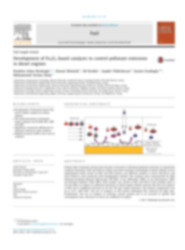
Development of Fe2O3 based catalysts to control pollutant emissions in diesel engines
Resitoglu, Ibrahim Aslan | Yıldırımcan, Saadet
Exhaust after treatment systems have become a necessity to eliminate pollutant emissions as required by standard. Nowadays, DOC and SCR are widely used after treatment technologies in diesel vehicles. In this experimental study carried on DOC and SCR systems, two different catalysts as Al2O3-TiO2/Fe2O3 and Al2O3-Pt/Fe2O3 were produced with impregnation method. The catalysts were characterized by Field Emission-Scanning Electron Microscope (FE-SEM), X-ray diffraction (XRD), X-ray fluorescence (XRF) and Brauner-Emmett-Teller (BET). Each catalyst was tested as DOC and SCR in real working state to see the effect of catalyst on pollutant emissions in diesel engine. Results showed that the use catalysts as DOC led to significant decrease in CO, HC, NO and smoke emissions. The exhaust temperature rose up to 50 degrees C after DOC. The use of catalysts in SCR system eliminated NOx emission by high rates. Furthermore; the use of catalysts in emission control systems led to an increase in specific fuel consumption and a decrease in excess air coefficient of engine. (C) 2017 Elsevier Ltd. All rights reserved.
Biodiesel production from free fatty acids and the effects of its blends with alcohol-diesel on engine characteristics
Resitoglu, Ibrahim Aslan
In this experimental study, biodiesel production from free fatty acids of soybean oil and the effects of its blends with alcohol-diesel on diesel engine performance and exhaust emissions were studied. Crude glycerine was neutralized to produce the free fatty acids. Methyl alcohol was reacted with the free fatty acids in the presence of acid catalyst to form biodiesel. Biodiesel, diesel, and alcohols were mixed at different volumetric ratios, and the properties of each blend were determined. The blends and diesel were tested in a single cylinder direct injection diesel engine at full-load conditions. In conclusion, torque and power characteristics of blends were found similar to those of diesel. Break specific fuel consumption of the blends slightly increased depending on lower heating values. CO and smoke emissions decreased up to 34.52 and 39.30 %, respectively. Although NOx emissions increased with B50, it showed a downward trend with alcohol-containing blends.

Hydrogen applications in selective catalytic reduction of NOx emissions from diesel engines
Resitoglu, Ibrahim Aslan
Diesel engines have been considered as a major source in nitrogen oxide (NOx) formation worldwide. The widespread use of diesel engines in consequence of their low fuel consumption, high durability and efficiency increases NOx emissions day by day. NOx emissions from diesel engines cause unavoidable damage on environment and people health. Although so many technologies such as exhaust gas recirculation (EGR), lean burn combustion, electronic controlling fuel injection systems, etc. have been developed to control NOx emissions from diesel engines, they couldn't meet the desired reduction in NOx emissions. In any case, Selective Catalytic Reduction (SCR) as one of the most promising aftertreatment-emission control technologies is an effective solution in restriction of NOx emissions. The use of SCR systems especially in heavy-duty diesel powered vehicles has been increasing nowadays. In these systems, to use of hydrogen (H2) as a reductant or promoter have been improved the conversion efficiency especially at low exhaust temperatures. Many researchers have been focused on the use of H2 in SCR systems for controlling NOx emissions. In this study, the applications of H2 in SCR of NOx have been discussed. The studies on use of H2 in SCR of NOx emissions were examined and the eff...
Using Pd(II) and Ni(II) complexes with N,N-dimethyl-N′-2-chlorobenzoylthiourea ligand as fuel additives in diesel engine
Resitoglu, Ibrahim Aslan | Avsar, Gokturk | Buldum, Barış
Fuel additives have been used to improve engine performance and also to reduce the pollutant emissions that occur after the combustion in engine. The effect of additions of bis-(N,N-dimethyl-N'-2-chloroben zoylthioureato) palladium (II), PdL2 and bis-(N, N-dimethyl-N'-2-chlorobenzoylthioureato) nickel (II), NiL2 complexes into diesel as metal additives was investigated experimentally. PdL2 and NiL2 complexes were added as 50 and 100 ppm to diesel and the properties (density, viscosity, calorific value, Cetane number, sulphur content, flash point, pour point and copper strip corrosion) of each test fuel were investigated. In general, the metal additives haven't led to major changes on fuel properties of diesel. However pour point values of additive blends reduced while flash point increased compared to diesel. All blends were tested in a four stroke single cylinder diesel engine to find out the performance and emission characteristic. The results revealed that the use of PdL2 and NiL2 complexes nickel has no significant effect on engine torque and brake power while considerable decrease was obtained for engine pollutant emissions (CO, NOx and smoke). Also the brake specific fuel consumption (BSFC) showed overall declining trend. (C) 2015 Elsevier Ltd. All rights res...
The pollutant emissions from diesel-engine vehicles and exhaust aftertreatment systems
Resitoglu, Ibrahim Aslan
Diesel engines have high efficiency, durability, and reliability together with their low-operating cost. These important features make them the most preferred engines especially for heavy-duty vehicles. The interest in diesel engines has risen substantially day by day. In addition to the widespread use of these engines with many advantages, they play an important role in environmental pollution problems worldwide. Diesel engines are considered as one of the largest contributors to environmental pollution caused by exhaust emissions, and they are responsible for several health problems as well. Many policies have been imposed worldwide in recent years to reduce negative effects of diesel engine emissions on human health and environment. Many researches have been carried out on both diesel exhaust pollutant emissions and aftertreatment emission control technologies. In this paper, the emissions from diesel engines and their control systems are reviewed. The four main pollutant emissions from diesel engines (carbon monoxide-CO, hydrocarbons-HC, particulate matter-PM and nitrogen oxides-NOx) and control systems for these emissions (diesel oxidation catalyst, diesel particulate filter and selective catalytic reduction) are discussed. Each type of emissions and control systems is compr...
DEVELOPMENT OF SEMI-SPHERICAL POROUS METAL MATRIX BURNER FOR COMBIES
Resitoglu, Ibrahim Aslan
In this study, a semi-spherical porous metal matrix burner was developed for boiler combies and other combustion systems. Unlike the conventional ceramic porous medium, metal matrix has been used as porous medium. Experimental investigations on performance of the burner have been carried out. Burner was tested at four different flow rates (0,048 kg/s, 0,075 kg/s, 0,105 kg's and 0,125 kg/s). Tests showed the temperature on the burner surface has reached up to 1174 K. Value of CO emission dropped under the limit values, and the value of 99,2% was obtained for the efficiency of combustion. As a result, because of excellent combustion, the emission values reduced, and the energy saving was obtained.

INFLUENCE OF TITANIUM BASED FUEL ADDITIVE ON DIESEL ENGINE PERFORMANCE AND EMISSIONS
Resitoglu, Ibrahim Aslan
Fuel additives provides an increase on engine performance and a reduction in the amount of the exhaust emissions as a result of improving fuel properties and combustion efficiency of internal combustion engines. In this experimental study, it is investigated the effect of using titanium (diizopropoksit bis) as a fuel additive on diesel engine and emissions. Titanium fuel additive and diesel fuel (D) were mixed with 25, 50, 75, 100 ppm values. In order to determine the performance and exhaust emissions characteristics, a single cylinder diesel engine was fuelled with blended fuels and tested at full load conditions. In conclusion, engine torques and power values of blended fuels were found to have similar values of diesel while specific fuel consumption values decreased. The use of titanium as a fuel additive has led to significant reductions in engine emissions. In particular, CO and soot emissions decreased up to 64.56% and 45.19% respectively.

The Influence of Diesel Fuel-biodiesel-ethanol-butanol Blends on the Performance and Emission Characteristics of a Diesel Engine
Resitoglu, Ibrahim Aslan | Sugözü, İlker
In this study, performance and exhaust emissions of a diesel engine fueled with Fuel A (60% diesel-30% biodiesel-5% ethanol-5% butanol) and Fuel B (40% diesel-50% biodiesel-5% ethanol-5% butanol) were investigated. The biodiesel produced from trap grease was obtained with an oil separator. Fuel A and Fuel B were tested in a single cylinder, four-stroke diesel engine at full load conditions. Compared with diesel fuel, the performance characteristics of blend fuels slightly deteriorated while the emission characteristics improved significantly. CO and HC emissions decreased by 87.01 and 87.50%, respectively.

The Optimization of the Esterification Reaction in Biodiesel Production from Trap Grease
Resitoglu, Ibrahim Aslan
In this experimental study, biodiesel production from waste oils (trap grease), which were obtained from an oil separator, was carried out by using sulfuric acid as the catalyst and esterification process. The main variables involved in the esterification process, including methanol/waste cooking oils ratio, amount of acid catalyst, reaction time, and reaction temperature, were analyzed. Because the waste cooking oils contain high free fatty acid above 65%, the esterification process has been preferred. Methanol was used as alcohol in this process because of its low cost, and sulfuric acid was preferred as the catalyst because it gives very high yields in alkyl esters. Experiments have been performed to determine optimum conditions for this esterification process in different molar ratios, catalyst amounts, reaction times, and reaction temperatures. The optimum experimental conditions, which were obtained from the esterification process, were methanol/waste cooking oils ratio 9/1, with 9 wt% sulfuric acid catalyst, reaction time 120 min, and reaction temperature 60 degrees C. The yield of biodiesel was 93.98% at optimum esterification process. Biodiesel and its blends with diesel were characterized for their physical properties referring to a substitute for diesel fuel. The resul...