 Erdal Yabalak
TEKNİK BİLİMLER MESLEK YÜKSEKOKULU KİMYA VE KİMYASAL İŞLEME TEKNOLOJİLERİ BÖLÜMÜ KİMYA TEKNOLOJİSİ PR.
Erdal Yabalak
TEKNİK BİLİMLER MESLEK YÜKSEKOKULU KİMYA VE KİMYASAL İŞLEME TEKNOLOJİLERİ BÖLÜMÜ KİMYA TEKNOLOJİSİ PR.
-
Varyant-
-
E-Postaerdalyabalak@mersin.edu.tr
-
Web Sitesi
-
Durum-
-
Ünvan-
-
YÖK Araştırmacı No15803
-



Application of the central composite design to mineralization of olive mill wastewater by the electro/FeII/persulfate oxidation method
Gözmen, Belgin | Görmez, Özkan | Yabalak, Erdal
The olive mill wastewater is a major environmental problem, which is waiting for effective treatment. In this study, the mineralization of olive mill wastewater was investigated using the electro/FeII/persulfate process. The central composite design was utilized to examine the effect of each experimental variables (concentration of persulphate and FeII, treatment time and constant current) on the mineralization of olive mill wastewater. The optimum chemical oxygen demand removal percentage was obtained as 71.2% where the reaction conditions were 200 mA current, 250 mM persulphate, 25 mM FeII, and 6 h reaction time. In addition, the maximum percentage of total phenolic removal and the energy consumption were 88% and 4.50 kWh/kgCOD, respectively, which were obtained at the same reaction conditions mentioned above. ANOVA test was used to examine the reliability of the experimental method. The R2 and adjusted R2 coefficients were obtained as 0.9634 and 0.9305, respectively. Optimum experimental parameters were determined and theoretical equations were obtained for the degradation of olive mill wastewater. For the treatment of olive mill wastewater, an environmentally friendly oxidation process was examined and the effect of each experimental variables was clearly demonstr...
The solubility of sebacic acid in subcritical water using the response surface methodology
Gözmen, Belgin | Görmez, Özkan | Yabalak, Erdal | Gizir, Ahmet Murat
The solubility of sebacic acid in subcritical water was investigated. Response surface methodology was used to study the combined effects of the different parameters such as temperature, static and dynamic time to optimize the process conditions for the maximum solubility of sebacic acid. Solubility results of sebacic acid were observed to be highly correlated with quadratic model according to analysis of variance. The solubility of sebacic acid was found as 500 g L-1 in the optimum conditions at 400 K temperature, 4 min dynamic time and 28 min static time. Approximation models were employed for determining solubility of sebacic acid at elevated temperatures.
Subcritical and supercritical fluid extraction of heavy metals from sand and sewage sludge
ERDAL YABALAK, AHMET MURAT GIZIR
Demetalization of Pb, Ni, Zn, Cu and Cr heavy metal ions from sea sand and real samples of sewage sludge by subcritical water and supercritical carbon dioxide was investigated. Experimental parameters such as temperature, pressure, extraction time in the static and dynamic mode and sampling were optimized in order to determine the suitable conditions for high removal of metals. The best extraction efficiencies were obtained using acetyl acetonate as a chelating agent in both subcritical water and supercritical CO2 extractions for real and artificial samples. Samples collected from extraction system using both subcritical water and supercritical carbon dioxide were analyzed by inductively coupled plasma mass spectrometry (ICP-MS). The highest recoveries obtained from real samples for Cr, Cu, Ni, Pb and Zn were 77.25, 95.1, 84.82, 94.92 and 98.39 %, respectively, using the chelating agent in the subcritical water extraction.
Spectrochimica Acta Part A: Molecular and Biomolecular Spectroscopy
The molecular structure and vibrational spectra of N-(3-tert-butyl-2-hydroxybenzylidene)-2,6-diphenyl-4-hydroxyaniline
Erdal Yabalak | Funda Günay | Hakan Arslan
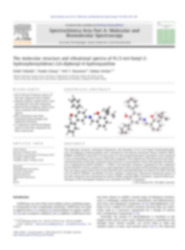
The molecular structure, vibrational frequencies and intensities of N-(3-tert-butyl-2-hydroxybenzylidene)-2,6-diphenyl-4-hydroxyaniline were calculated by the Density Functional Theory methods (BLYP, B3PW91 and B3LYP) using the 6-31G(d,p) basis set. The calculated geometric parameters were compared to the corresponding X-ray structure of the title compound. The comparison of the theoretical and experimental geometry of the title compound shows that the X-ray parameters fairly well reproduce the geometry of optimized by B3LYP method (r = 0.9825). The harmonic vibrations computed for this compound by the B3LYP/6-31G(d,p) method are in good agreement with the observed IR and Raman spectral data. The root mean square values error of the observed and calculated IR bands are found to be 9.80, 9.40 and 8.42 for B3LYP, B3PW91 and BLYP/6-31G(d,p) methods, respectively. Theoretical vibrational spectra of the title compound were interpreted by means of PEDs using the SQM 2.0 program. A general better performance of the investigated methods was calculated by PAVF 1.0 program.