İlker Sugözü
MÜHENDİSLİK FAKÜLTESİ MAKİNE MÜHENDİSLİĞİ BÖLÜMÜ OTOMOTİV ANABİLİM DALI
İlker Sugözü
MÜHENDİSLİK FAKÜLTESİ MAKİNE MÜHENDİSLİĞİ BÖLÜMÜ OTOMOTİV ANABİLİM DALI
-
Varyant-
-
E-Postailkersugozu@mersin.edu.tr
-
Web Sitesi
-
Durum-
-
Ünvan-
-
YÖK Araştırmacı No13502
-


Tribological and mechanical behavior of boric acid and borax containing brake pad
Sugözü, İlker | Sugözü, Banu
Vehicle brake pads are formed as a result of combining different materials. In this study, boric acid and borax were used in vehicle brake pad content. Boric acid and borax were added to the pad content at 1%, 3%, 5% and 7%, and braking performance was compared. The braking performance of the produced pads was determined using a pin-on-disc friction test device. The specific wear rate, hardness and density values of the pad samples were determined. The brake pad containing 7% boric acid and borax achieved a braking performance close to the highest value among the values specified in the standards.

Impact of Boric acid and Colemanit addition on tribological behavior and braking performances of brake lining
Sugözü, İlker | Sugözü, Banu
Brake lining is formed as a result of combining different materials. The materials used in the brake lining are an important factor in the brake lining performance. In this study, boric acid and colemanite, one of the boron products with high temperature resistance, were used as brake lining materials. 1%, 3%, 5% and 7% boric acid and colemanite were added to the brake lining content. The tribological properties of the brake linings were examined with a pin-on disc tester. The friction performance increased as the boric acid and colemanite ratio increased in the brake lining content. As the boric acid and colemanite ratio increased, the hardness and density of the brake lining increased, and the wear resistance decreased.
Effect of micro and nano-sized ZrSiO4 particles on the friction and wear properties of polymer matrix composites
Sugözü, Banu | Sugözü, İlker
In this study, the size effect of zircon (ZrSiO4) on the tribological characteristics of polymer matrix friction composites were investigated. Hence, four friction composites containing micro and nano-sized zircon particles (5 and 10 wt%) were developed and produced using powder metallurgy method. Their wear and friction characteristics were examined using a friction-wear test device. The weight loss and specific wear rate were measured and compared with that obtained for microsized zircon particles. The surfaces of samples were analyzed using a scanning electron microscope, and less wear was observed in the samples containing nano-sized zircon particles. The results revealed that the size of abrasive particles plays a key role in enhancing the friction coefficient and friction stability.

Effects of Boron minerals on the mechanical and tribological properties of brake friction materials
Sugözü, Banu | Sugözü, İlker
Brake liningsrise to high temperatures as a result of friction. The high temperature caused by friction causes brake weakening and extends the stopping distance of the vehicle as an undesirable situation. In this study, high temperature resistant boron minerals Colemanite, Ulexite, Borax and Boric Acid were used in brake lining content. Colemanite, Ulexite, Borax and Boric Acid have been added to the brake lining content at rates of 1%, 3%, 5% and 7% by mass. Friction and wear performances of the produced brake liningswere determined with a pin-on-disc tester. As the Bo mineral content increased, the friction performance of the brake lining increased positively. Depending on the increase in boron mineral, hardness and density values also increased. It has been determined that it is appropriate to use boron mineral in order to slow down the rate of increase of high temperature ratios caused by friction in brake linings.

Effect of Ulexite and Boric acid on the friction characteristics of non-asbestos brake pad
Sugözü, Banu | Sugözü, İlker
Brake pads are used to slow down or stop the vehicle by applying force to the disc surface. The most important parameter in brake pad is friction coefficient. The higher the friction coefficient, the shorter the braking distance will be. Different materials are used to increase the friction performance of the brake pad. A limited number of studies have been carried out to increase the friction performance of brake pads by using boron mineral with high temperature resistance. In this study, brake pad was produced by using boron mineral ulexite and boric acid and its effect on braking performance was investigated. Four different brake pad samples containing 1%, 3%, 5%, 7% ulexite and boric acid were produced by powder metallurgy method. Production parameters are the same for all brake pad samples. The specific wear rate and friction coefficient of the brake pad samples were obtained with a pin-on-disc type tribometer using a gray cast iron disc. The hardness and density values of the brake pad samples were determined and compared with each other. When compared with the literature data, it has been observed that the use of ulexite and boric acid in brake pad composites significantly and beneficially affects braking performance. In addition, it has been observed that the amount of ul...
Production of boric acid added brake friction composite and the effect of heat treatment on braking characterization
Sugözü, İlker | Sugözü, Banu
Purpose The purpose of this study was to investigate the use of boric acid as a friction modifier material in brake friction composites and to determine the effect of heat treatment applied during production on braking performance. Design/methodology/approach The addition of five different amounts of boric acid was balanced with cashew, which is in the friction modifier material group. The samples were produced in the following order: dry mixing, preforming and hot-pressing. The effect of the heat treatment that can be applied after the hot-pressing process on the braking performance was investigated. The tribological and physical properties of the samples were determined using tests performed according to appropriate standards. The microstructures of the friction surfaces were investigated using scanning electron microscopy. Findings It was observed that the tribological properties of brake friction composites containing 20% by weight of boric acid were improved. It has also been observed that the heat treatment applied after hot pressing increased the friction coefficient of the samples by 7% on average and decreased the specific wear ratio of the samples. When the surface morphologies of the samples are examined, it is seen that the friction layers of the heat-treated samples ...
Investigation of The Effect of Solid Lubricant Particle Sizes on Friction and Wear Properties in Friction Composites: An Experimental Case Study with Graphite
Sugözü, İlker | Sugözü, Banu
Friction composites consist of many materials with various properties. Solid lubricant is one of these materials. The task of the solid lubricant in the compo-site is to protect the counter surfaces against wear and to reduce noise and vibra-tion. Typical solid lubricants used in the friction composite are graphite, antimo-ny trisulfide, molybdenum disulfide, copper sulfide, etc. The selection suitable solid lubricants for better braking performance is an important issue, as solid lubricants may decompose at high temperatures, leading to undesirable results. The particle size of the solid lubricant used is at least as important as itself. In this study, the effect of micro and nanoparticle-sized graphite on friction and wear behavior of friction composites was investigated experimentally. Two brake lining were prepared containing 10 wt.% nanographite and micrographite, were produced by powder metallurgy technique. The brake lining samples have been tested under Friction Assessment and Screening Test (FAST). The frictional and physical properties of the produced samples were determined by appropriate tests. According to the test results obtained, micro and nanoparticle size were compared in many respects and the most ideal size was determined for graphite.
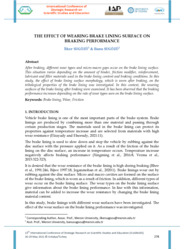
The Effect of Wearing Brake Lining Surface on Braking Performance
Sugözü, İlker | Sugözü, Banu
After braking, different wear types and micro-macro gaps occur on the brake lining surface. This situation varies depending on the amount of binder, friction modifier, reinforcement, lubricant and filler materials used in the brake lining content and braking conditions. In this study, the effect of brake lining surface morphology, which is worn after braking, on the tribological properties of the brake lining was investigated. In this context, the wearing surfaces of the brake lining after braking were examined. It has been observed that the braking performance increases depending on the rate of wear types seen on the brake lining surface.
The Effect of Braking Pressure on Friction and Wear Properties of Brake Lining
Sugözü, İlker | Sugözü, Banu
The brake system is used to slow down or stop the vehicle speed. The brake lining is the most important part of the brake system, which is used to slow down or stop the vehicle by converting friction energy into heat energy. The pressure applied to the linings in the vehicle brake system is an important factor for the lining performance. The brake lining exhibits different properties depending on the pressure applied during braking and the brake lining content. In this study, friction coefficient and wear properties of brake linings at braking pressures of 5, 10 and 15 bar were investigated. The pressure increase increased the disc surface temperature and the wear amount of brake lining.

Examination of the Tribological Properties of Brake Pads with Different Hardness Characteristics
Sugözü, Banu | Sugözü, İlker
Brake pads consist of a combination of different materials such as binder, friction adjuster, reinforcement material, lubricant and filler material. Brake pads are produced by using certain proportions of materials containing these components. The tribological properties of the brake pad differ according to the material content of the brake pad composition. The physical properties of the produced brake pads are another factor affecting the tribological properties of the brake pads. In this study, brake pads with different hardness properties were produced. By examining the braking performance of the produced brake pads, its effect on tribological properties has been determined.

Investigation of the Effect of Surface Roughness on Friction Performance of Brake Pad
Sugözü, Banu | Sugözü, İlker
Vehicle brake pads are produced by combining more than one material. Having different properties of the material forming the brake pad composition is affect to the friction performance of the vehicle. During braking, high temperatures occur in the vehicle brake pads. Depending on the temperature change, the friction coefficient and wear resistance of the brake pad are desired to be high. In this study, the effect of brake pad surface roughness on friction performance was investigated. The friction coefficient and wear tests of the brake pads with different surface roughness values were examined and their effect on the friction performance was determined.
Friction and Wear Properties of Automobile Brake Linings Containing Borax Powder with Different Grain Sizes
Sugözü, İlker | Sugözü, Banu
Borax which is an important boron compound, a mineral, and a salt of boric acid, is used as a fire retardant and insulating material. The most important reac-tion in automobile brake systems is heat generation from friction. The heat gen-erated at the interface of disc and lining may cause deformation of the materials forming the lining. Therefore, phenomena such as lining wear and brake fade may be occurred. The aim of this study is to reveal the positive effects of borax additive on lining and experimentally examine the effect of grain size of borax on tribological properties. Lining is produced by mixing more than one powder materials and pressing cold and hot. The size and homogeneous mixture of pow-der materials affect the braking performance. In this study, the effect of using nano and micro sized borax with the same content on the lining performance was investigated. The produced linings were tested on pin-on disc tester. Wear, hard-ness and density tests were performed. The change in the friction coefficient was observed due to the temperature increase. The friction coefficient of the nano-containing lining showed a more stable result depending on the temperature.

Investigation of the Use of a New Binder Material in Automotive Brake Pad
Sugözü, Banu | Sugözü, İlker
In this study, the usability of waste banana peel and banana tree bark with a fibrous structure as binders was investigated experimentally. Ac-cordingly, the amount of fiber, friction regulator, filler, abrasive and sol-id lubricant is fixed, and three different brake pad samples were pro-duced by adding 10% banana peel and 10% banana tree bark powders by reducing the amount of phenolic resin. Production was carried out by conventional dry mixing method and powder metallurgy method. For this, firstly a homogeneous mixture of all ingredients is provided. The mixture transferred to the mold was pressed at room temperature firstly. Samples obtained as the first form were subjected to hot pressing in the mold again. Thus, the ability of the resin to hold all the materials together has become active. Finally, the samples were cleaned and prepared for the tests. To examine the braking performance of the produced pads, a specially designed brake tester with brake disc was used. Friction, wear, density and hardness tests of the pads were made. SEM images of friction surfaces of pads were taken and microstructures were examined. The ef-fect of using banana waste as a binder in the brake pad on braking per-formance was evaluated. As a result, it was observed that banana wastes are alternat...
Investigation of Usage of Milled Pine Cone in Brake Pads
Sugözü, İlker | Sugözü, Banu
Automotive brake pads are polymer composites containing polymer matrix and various fibers and obtained by mixing and pressing different powder materials. Each material added to the content has one or more tasks. Therefore, the properties and quantities of the materials added to the content are very important in terms of braking performance. In this study, the use of milled pinus brutia cone and pinus nigra cone from the pine cone family in the automotive brake pad was investigated experi-mentally. First of all, cones are ground and powdered. The milled 10% pinus brutia cone and 10% pinus nigra cone were added to the pad com-ponent. The performance tests of the pads were carried out on pin on disk type test device. Friction coefficient, wear, density and hardness tests of the pads were done. The test results have been shown to affect the brak-ing performance of milled pine cone.
Effect of process for manufacturing a brake lining on tribological properties: an experimental study for hot pressing pressure
Sugözü, Banu | Sugözü, İlker
Production of composite brake linings; mixing, cold and hot pressing (molding) and heat treatment steps. The aim of this study is to investigate the effect of hot-pressing pressure on friction performance in the production of composite brake linings. As the pressure applied during the hot-pressing step increases, the density of the product increases as the gap between the materials forming the product decreases. Therefore, the pressing pressure, which is one of the production parameters, is very important for the friction performance of composite brake lining materials. In this study, composite brake lining samples having the same content were produced by applying three different hot-pressing pressures such as 8000, 13000, 18000 kPa and friction performances were examined. The friction coefficients of the samples with 13000 and 18000 kPa pressing pressure were low. The most suitable pressing pressure was determined as 8000 kPa.
Investigation of Friction and Wear Behavior of Boron Carbide Reinforced Composite Materials
Sugözü, Banu | Sugözü, İlker
In this study, the usability of boron carbide as a reinforcement material in friction composites was investigated experimentally. Hence, composite samples containing different amounts of boron carbide (5%, 10% and 15%) were produced and compared with boron carbide-free sample. Friction and wear tests were determined by a full scale brake friction tester according to TS 555 and TS 9076 standards. The hardness of the samples was calculated by Rockwell hardness tester and the density was calculated according to Archimedes' principle. The results showed that boron carbide could be used as a reinforcement material in friction composites.

The effect of ulexite to the tribological properties of brake lining materials
Sugözü, İlker | Sugözü, Banu
Recently, different brake pads have started to be investigated in brake friction industry by replacing the asbestos with new materials. This paper presents the role of Ulexite on friction assessment and screening Test of newly formulated brake pads. Friction coefficient, specific wear ratio, and scanning electron microscope SEM for friction surfaces were examined to assess the performance of brake pads. From the results, they concluded that the friction material containing Ulexite improved friction stability and fade resistance. Further, for heat treated samples they claimed a higher and stable friction coefficient
The effect of colemanite on the friction performance of automotive brake friction materials
Sugözü, İlker | Sugözü, Banu
Purpose The purpose of this paper is to investigate use of colemanite (C) upon friction and wear performance of automotive brake lining. Brake lining production with the boron product colemanite addition and braking characterization investigated for development of non-asbestos organic (NAO) brake lining because of negative effects on human health and environmental hazard of asbestos containing linings. During the braking, brake lining is warmed up extremely due to friction, and the high temperature causes to decreasing of breaking performance. Colemanite has high melting temperature, and this makes this material valuable for brake lining. Design/methodology/approach This study investigated the effect of colemanite (C) upon friction and wear performance of automotive brake lining. Based on a simple experimental formulation, different amounts of boron product colemanite were used and then evaluated using a friction assessment and screening test. In these specimens, half of the samples (shown with H indices) were heat treated in 4 h at 180°C temperature. Friction coefficient, wear rate and scanning electron microscope for friction surfaces were used to assess the performance of these samples. Findings The results of test showed that colemanite can substantially improve properties of...
The effect of different dwell times at a constant pelletization pressure of 6 GPa on superconducting properties of Bi1.8Sr2Ca1.1Cu2.1Oy ceramics
Sugözü, Banu | Sugözü, İlker
In this study, the physical and magnetic properties of Bi1.8Sr2Ca1.1Cu2.1Oy superconductors kept in different dwell times (1, 6, and 12 h) at a constant pelletization pressure of 6 GPa in the pressing step as prepared by standard solid-state reaction method are reported. The X-ray diffraction data shows that all samples have a tetragonal crystal structure with predominant Bi-2212. SEM micrographs for all samples predominately show plate-like grain structure, indicating the presence of Bi-2212 phase. Both Tc (onset) and Tc (offset) significantly increase with increasing dwell time. M–H measurements were performed at T = 10 and 25 K, respectively. In addition, Jc values of the samples were calculated from their magnetic hysteresis loops using the Bean’s model. It has been found that Jc in the samples including long dwell times under the pelletization pressure of 6 GPa improves.

POWDER MATERIALS USED IN AUTOMOTIVE BRAKE PAD
Sugözü, İlker | Sugözü, Banu
GEMİ BAKIM VE ONARIM SEKTÖRÜNDE ÇALIŞANLARIN İŞYAŞAMINDA STRES
Sugözü, İlker | Sugözü, Banu




ALTERNATIVE MATERIALS USED IN BRAKE LINING
Sugözü, İlker | Sugözü, Banu


EFFECT OF PAD DENSITY ON BRAKING PERFORMANCE
Sugözü, İlker | Sugözü, Banu