

-
BIOLOGY OF REPRODUCTION3
-
CRYOBIOLOGY3
-
Journal of Animal and Veterinary Advances3
-
Eurasian Journal of Veterinary Sciences2
-
Biotechnology & Biotechnological Equipment1
-
Biotechnology & Biotechnological Equipment1
-
Fresenius Environmental Bulletin1
-
J.ournal of FisheriesSciences.com.1
-
JOURNAL OF ANIMAL AND VETERINARY ADVANCES1
-
Journal of Endodontics1
Konaklama işletmelerinde bilgi yönetimi: Antalya’daki beş yıldızlı otellerde bir uygulama
Tetik, Dilek
Günümüzde bilgi, işletmeler için önemli bir üretim faktörü ve en önemli stratejik kaynak haline gelmiş bulunmaktadır. Günümüzde işletmelerin rekabet üstünlükleri sermaye ve hammadde gibi geleneksel kaynaklardan çok bilgiye dayanmaktadır. Bilgiden söz konusu rekabet üstünlüğünü yaratabilmek; gerek duyulan bilgilerin edinilmesi, üretilmesi, düzenlenmesi, saklanması, paylaşılması ve ürünlerde, hizmetlerde, kararlarda ve süreçlerde uygulamaya geçirilmesi şeklinde bir dizi süreci gerektirmektedir. Öte yandan bilginin bir sistem dahilinde yönetilmesi, buna uygun bir altyapının varlığını da gerektirmektedir. İşlevsel bilgi ve iletişim teknolojileri, bilgi paylaşımına açık bir kurum kültürü, esnek bir örgüt yapısı ve nitelikli insan sermayesi bilgiden değer yaratmak için gereksinim duyula...

VIII. Sebze Tarımı Sempozyumu (23-26 Haziran 2010 Van) Bildiri Kitabı
CEMALOĞLU, Nazmi
Serada organik domates yetiştiriciliğinde bitki besleme.
The Tumor Necrosis Factor-A -308 G/A Polymorphism and the Tumor Necrosis Factor-Related Apoptosis-Inducing Ligand Polymorphisms, in Asthmatic Patients and Healthy Subjects
Erdal, Mehmet Emin | Ay, Özlem İzci
Asthma is a chronic inflammatory disorder of the airways in which many cells and cellular elements play a role. Like other atopic diseases, asthma is a complex disorder caused by interactions between multiple genes of small to modest effect and equally important environmental factors. The aim of this study was to determine the TNF-α -308 G/A polymorphism and the TRAIL polymorphisms, and their influence on asthma in asthmatic patients and healthy subjects. The study population consists of 51 asthmatic patients (47 female and 4 male) and 72 healthy subjects (62 female and 10 male). The mean age of the asthmatic patients and healthy controls were 45.33±14.05, and 41.88±17.41 years, respectively. The asthmatic patients and healthy controls were similar with respect to their ages and sex charac...
The effect of cysteine and glutathione on sperm and oxidative stress parameters of post-thawed bull semen
Tuncer, Pürhan Barbaros | Büyükleblebici, Serhat
The aim of this study was to determine the effects of antioxidants such as reduced glutathione (GSH) and cysteine in Laiciphose extender on semen parameters, fertilizing ability, lipid peroxidation (LPO) level and glutathione peroxidise (GPx) activity of post-thawed bull semen. Totally 54 ejaculates of three bulls were used in the study. Five groups, namely; GSH (0.5 and 2 mM), cysteine (5 and 10 mM) and control group, were conducted to test the antioxidants in Laiciphose . Insemination doses were processed that each 0.25-mL straw contained 15 106 sperm. The addition of antioxidants did not present any significant effect on the percentages of post-thaw sperm morphology (acrosome and total abnormalities), subjective, CASA and progressive motilities, as well as sperm motility characteristics...
Evaluationofpost-thawqualityofBrown-SwissandHolsteinbullsemendilutedwith different extenders
Tuncer,, Pürhan Barbaros
Aim: To evaluate post-thaw guality of Brown-Swiss and Holstein bull semen diluted with different extenders. Materials and Methods: Ejaculates obtained from Holstein (n=36) and Brown-Swiss (n=36) bulls were divided into three aliquots and diluted with Tris-based, Optidyl® and Bioxcell® extenders, respectively. Thereafter they were frozen and thawed following a standard protocol. The effectiveness of freezing extenders was assessed according to postthaw sperm motility, acrosomal and total abnormalities and plasma membrane integrity. Results: With respect to Holstein bull semen, the highest percentages of sperm subjective (p


Effects of Chromium on the Hematocrit Levels and Erythrocyte Numbers of Cyprinus carpio
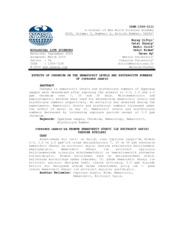
Cicik, Bedii | Çiftçi, Nuray | Ay, Özcan
Changes in hematocrit levels and erythrocyte numbers of Cyprinus carpio were determined after exposing the animals to 0.5, 1.0 and 2.0 ppm chromium over 7, 15 and 30 days. Microhematocrit and hemocytometric methods were used for determining hematocrit levels and erythrocyte numbers respectively. No mortality was observed during the experiments. Hematocrit levels and erythrocyt numbers increased under the effect of metal on day 15. Hematocrit levels and erythtrocyte numbers decreased by increasing exposure periods except at 0.5 ppm chromium.