



Novel 1,4-naphthoquinone N-aroylthioureas: Syntheses, crystal structure, anion recognition properties, DFT studies and determination of acid dissociation constants
Gemili, Müge | Nural, Yahya
In this paper, five novel 1,4-naphthoquinone N-aroylthiourea derivatives were synthesized, by the reaction of 2,3-diaminonaphthalene-1,4-dione and aroylisothiocyanates, in excellent yield (88-96%) and characterized by using FT-IR, H-1/C-13 NMR and HRMS. In addition, the molecular structure of one of the 1,4-naphthoquinone N-aroylthiourea compounds was characterized by single crystal X-ray diffraction studies. The absorption spectra of the compounds were determined in DMSO and the dyes have absorption in visible region in the range of 464-477 nm. The chemosensing ability of each of the prepared dyes was assessed by titrating them towards the anions; F-, Cl-, Br-, I- AcO-, CN-, CIO4-, H2PO4-, HSO4-, and NO3-, using spectrophotometric and H-1 NMR titration techniques in DMSO, experimentally. ...
Pt(II) and Ni(II) complexes of octahydropyrrolo[3,4-c]pyrrole N-benzoylthiourea derivatives: Synthesis, characterization, physical parameters and biological activity
Gemili, Muge | Ulger, Mahmut | Nural, Yahya
In this study, four novel Pt(II) and Ni(II) complexes of octahydropyrrolo[3,4-c]pyrrole, consisting of pyrrolidine fused to pyrrolidine-2,5-dione, N-benzoylthiourea derivatives were synthesized and their structural characterization was performed by NMR, FT-IR, MS, HRMS and elemental analysis techniques and single crystal X-ray diffraction studies. The octahydropyrrolo[3,4-c]pyrrole N-benzoylthiourea compound 3c crystallizes triclinic, with space group P-1. Pt(II) and Ni(II) ions created cis-complexes Pt(II) 4c and Ni (II) 5a forming distorted square-planar structures in orthorhombic space groups Pnma and Pbca, respectively. Furthermore, the ligands behave as bidentate and bind to the metal atom via the S and O atoms. Acid dissociation constants of the ligands were determined by potentiomet...
Synthesis and anti(myco)bacterial activity of novel 5,5-diphenylpyrrolidine N-aroylthiourea derivatives and a functionalized hexahydro-1H-pyrrolo[1,2-c]imidazole
Ersen, Duygu | Ulger, Mahmut | Gemili, Muge | Nural, Yahya
In this paper, five novel 5,5-diphenylpyrrolidine N-aroylthiourea derivatives were synthesized by stereoselective cycloaddition of N-diphenylmethylene-protected glycine methyl ester and methyl acrylate, and subsequent coupling with aroylisothiocyanates. The cis-stereochemistry of one of the heterocyclic thiourea derivatives was characterized by single crystal X-ray diffraction studies. The compounds showed antibacterial activity against Staphylococcus aureus, Bacillus subtilis, Aeromonas hydrophila, Escherichia. coli and Acinetobacter baumannii with minimum inhibitory concentration values in the range of 62.5-1000 mu g/mL against these bacterial strains. Antimycobacterial activity of the compounds was investigated against the M. tuberculosis H37Rv strain and all compounds exhibited antimyc...
Investigation of The Effect of Acylthiourea Derivatives on Diabetes-Associated Enzymes
Nural Yahya
One of the most prevalent chronic metabolic disorders, diabetes mellitus, is defined by chronic hyperglycemia and the emergence of microvascular and macrovascular pathology unique to diabetes. Several diabetes problems are primarily caused by persistent hyperglycemia. In this study, aldose reductase (AR) and sorbitol dehydrogenase (SDH) enzymes were purified using chromatographic techniques from sheep kidneys and alpha-glycosidase purchased commercially. The inhibitory effect of seven acylthiourea compounds on the activity of these enzymes associated with diabetes was investigated. As a result of the studies, the acyl thioureas showed an inhibition effect at the micromolar level on the activity of studied enzymes. The most active compound dimethyl 1-((4-methoxybenzoyl)carbamothioyl)-5,5-di...
Acyl thiourea derivatives: Versatile tools for chemosensing and heavy metal remediation
Selcuk, Ozge | Nangyallai, Azizi | Nural, Yahya
The increasing environmental pollution, particularly from heavy metals and hazardous anions, poses a significant threat to global health and ecosystems. The unique structural features of these compounds, including multiple coordination sites, enhanced electron density, favorable steric effects, and stabilized metal-ligand complexes, enable their effective application in both chemosensing and heavy metal remediation. As chemosensors, acyl thiourea derivatives exhibit high sensitivity and selectivity in detecting various cations, anions, and neutral species, making them valuable tools for in situ environmental analysis. Additionally, their ability to efficiently adsorb heavy metals like Cu2+, Hg2+, Cd2+, U4+, Pb2+, Pt4+, and Pd2+, along with the removal of Cl− from acidic wastewater, demonst...
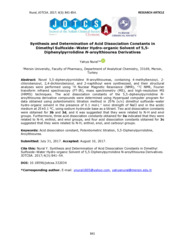
Synthesis and Determination of Acid Dissociation Constants in Dimethyl Sulfoxide–Water Hydroorganic Solvent of 5,5-Diphenylpyrrolidine N-Aroylthiourea Derivatives
Nural, Yahya
Novel 5,5-diphenylpyrrolidine N-aroylthioureas, containing 4-methylbenzoyl, 2- chlorobenzoyl, 2,4-dichlorobenzoyl, and 2-naphthoyl were synthesized, and their structural analyses were performed using 1H Nuclear Magnetic Resonance (NMR), 13C NMR, Fourier transform infrared spectroscopy (FT-IR), mass spectrometry (MS), and high-resolution MS (HRMS) techniques. The acid dissociation constants of the 5,5-diphenylpyrrolidine Naroylthiourea derivative compounds were determined using Hyperquad computer program for data obtained using potentiometric titration method in 25% (v/v) dimethyl sulfoxide–water hydro-organic solvent in the presence of 0.1 molL 1 ionic strength of NaCl and in the acidic medium at 25±0.1 °C, using sodium hydroxide base as a titrant. Two acid dissociation constants ...
Synthesis of novel acylthioureas bearing naphthoquinone moiety as dual sensor for high-performance naked-eye colorimetric and fluorescence detection of CN− and F− ions and its application in water and food samples
Nural, Yahya | Karasu, Elize | Efeoglu, Cagla
In this study, six new acylthiourea, bearing naphthoquinone moiety, sensors were synthesized in high yield (88-96%) and characterized using H-1/C-13 NMR, FT-IR and HRMS techniques. All synthesized sensors (4a-f) showed shifts in absorbance and colorimetric changes by CN-, F-, AcO-, and H2PO4-. However, 4e showed a chromogenic different sensitivity response to CN- and F- against competing anions such as AcO- and H2PO4- in DMSO. Furthermore, CN- added 4e showed an increase at the emission intensity and intensive fluorimetric color change was observed in UV-light (lambda ex. 365 nm). All sensors showed chromogenic selectivity towards CN- in aqueous solutions (in DMSO/H2O: 1:1, v/v). Interaction mechanisms between 4e and CN- and F- anions were investigated by experimental studies using various...
Synthesis of Ni(II), Pd(II) and Cu(II) metal complexes of novel highly functionalized aroylaminocarbo-N-thioyl pyrrolidines and their activity against fungi and yeast
Nural, Yahya | Dondas, Haci Ali | Serin, Mehmet Sami | Ince, Tuncay
A series of Ni(II), Pd(II) and Cu(II) metal complexes of highly functionalized aroylaminocarbo-N-thioyl pyrrolidines were prepared and characterized by microanalysis, spectroscopic methods, magnetic susceptibility measurements and single crystal X-ray diffraction studies. The antifungal activity of the metal complexes against the yeast Saccharomyces cerevisae and against the fungus Penicillium digitatum was studied.
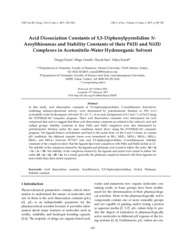
Acid Dissociation Constants of 5,5-Diphenylpyrrolidine NAroylthioureas and Stability Constants of their Pt(II) and Ni(II) Complexes in Acetonitrile-Water Hydroorganic Solvent
Ersen, Duygu | Gemili, Muge | Nural, Yahya
In this study, acid dissociation constants of 5,5-diphenylpyrrolidine N-aroylthiourea derivatives, exhibiting anti(myco)bacterial activity, were determined by potentiometric titration in 30% (v/v) acetonitrile-water hydroorganic solventat 25 ± 0.1 °C, at an ionic background of 0.1 mol / L of NaCl using the HYPERQUAD computer program. Three acid dissociation constants were determined for each compound 1a-e and we suggest that these acid dissociation constants are related to the carboxyl, enol and enthiol groups. Stability constants of their Pt(II) and Ni(II) complexes were also determined by potentiometric titration under the same conditions stated above using the HYPERQUAD computer program. The ligands behave as bidentate and bind to the metal atom via the S and O atoms. In various p...