

Relationship Between Death Anxiety of Turkish Nurses and Their Attitudes Toward the Dying Patients
Yıldız Ebru | Lafçı Diğdem
This study aims to investigate the relationship between death anxiety of the Turkish nurses and their attitudes toward the dying patient. This study involved 203 nurses who were working at a university hospital. The data were collected using “Nurse Information Form” (which was prepared by the authors of this research), “Thorson-Powell Death Anxiety Scale,” and “Attitude Scale about Euthanasia, Death, and Dying Patient.” There was a positive correlation between death anxiety and dying patient avoidance behavior and euthanasia score (p

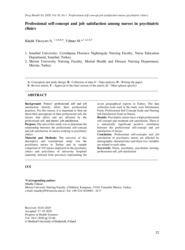
Professional self-concept and job satisfaction among nurses in psychiatric clinics
Yılmaz, Mualla
Background: Nurses’ professional self and job satisfaction directly affect their professional practices. For this reason, it is important to find out about their perceptions of their professional self, the factors that affect and are affected by the professional self, and nurses’ job satisfaction. Purpose: The aim of this study was to determine the relationship between the professional self-concept and job satisfaction of nurses working in psychiatry clinics. Material and Methods: The universe of this descriptive and correlational study was the psychiatric nurses in Turkey and its sample comprised of 103 nurses employed in the psychiatry clinics and polyclinics of university hospitals randomly selected from provinces representing the seven geographical regions in Turkey. The data collectio...
Nurses' views and applications on palliative care
Diğdem Lafci | Ebru Yildiz
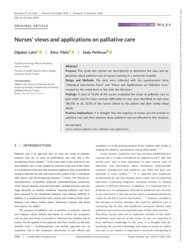
Purpose: This study was carried out descriptively to determine the view and applications about pallative care of nurses working in a university hospital. Design and Methods: The data were collected with the questionnaire form: “Individual Information Form” and “Views and Appllications on Palliative Care,” created by the researchers in line with the literature. Findings: A total of 96.6% of the nurses evaluated the scope of palliative care as pain relief, and the most common difficulties in care were identified as bad news (88.1%). In all, 22.0% of the nurses talked to the patient and their family about death. Practice Implications: It is thought that the majority of nurses are not trained in palliative care and their opinions about palliative care are affected by this situation.

Nurses' views and applications on palliative care
Lafci, Diğdem | YILDIZ, Ebru
Purpose: This study was carried out descriptively to determine the view and applications about pallative care of nurses working in a university hospital. Design and Methods: The data were collected with the questionnaire form: “Individual Information Form” and “Views and Appllications on Palliative Care,” created by the researchers in line with the literature. Findings: A total of 96.6% of the nurses evaluated the scope of palliative care as pain relief, and the most common difficulties in care were identified as bad news (88.1%). In all, 22.0% of the nurses talked to the patient and their family about death. Practice Implications: It is thought that the majority of nurses are not trained in palliative care and their opinions about palliative care are affected by this situation