
Tilapia nilotica L 1758 nin Solungac ve Karaciger Dokularindaki Mangan Demir ve Cinko Duzeyleri Uzerine Bakirin Etkisi
Ahmet Erdem Dönmez, | Cafer Erkin Koyuncu
Tilapia nilotica (L., 1758) 7 ve 14 günlük sürelerle 2,0 ve 4,0 ppm bakır ortam derişimlerinde tutularak, bakırın karaciğer ve solungaç dokularındaki mangan, demir ve çinko elementleri düzeyine etkisi belirlenmiştir. Yaş yakma yöntemi ile analize hazırlanan doku örneklerinin element düzeyleri, atomik absorpsiyon spektrofotometresi yardımıyla kuru ağırlık olarak hesaplanmıştır. Bakır, solungaç dokusuna göre karaciğer dokusu element düzeyini daha fazla etkilemiştir. Ancak solungaç dokusu demir düzeyi 14. günde 4 ppm ortam derişiminde, çinko düzeyi ise 7. günde aynı ortam derişiminde istatistik ayrım gösterecek şekilde değişmiştir. Genel anlamda bakır karaciğer dokusundaki mangan, demir ve çinko elementleri düzeyinde artışa neden olmuştur.
Effects of Diazinon on 17β-estradiol, Plasma Vitellogenin and Liver and Gonad Tissues of Common Carp (Cyprinus carpio, L., 1758)
Korkmaz Cengiz | Dönmez Ahmet Erdem
Both sexes of Common carp (Cyprinus carpio) exposed to sublethal concentrations (0.488 mg/L and 0.976 mg/L) of the widely used insecticide diazinon for a period of 7, 15, 30 days and effects on plasma 17β-estradiol (E2), vitellogenin (VTG), gonad and liver tissues were examined. In male carps, 0.488 mg/L and 0.976 mg/L diazinon elevated E2 levels following on the 7, 15 and 30 days. Both concentrations of diazinon elevated VTG levels after 15 days in males. In female carps, 0.976 mg/L diazinon elevated E2 levels after 30 days. However, 0.488 mg/L and 0.976 mg/L diazinon reduced VTG levels in female carps, at the end of experiment. Histopathological examination of liver showed dilatation of the bile ducts and sinusoids, congestion, lymphocytic infiltration, pigment accumulation and necrosis ...
Influence of Lead on Reproductive Physiology and Gonad and Liver Histology of Female Cyprinus carpio
Cengiz Korkmaz, Özcan Ay, Ahmet Erdem Dönmez, Burcu Demirbağ
Sera 17β-estradiol (E2), 11-ketotestesteron (11-KT) and 17,20-β-dihydroxy-4-pregnen-3-one (17,20βP) levels together with histological changes in liver and gonad tissues were determined after exposing sexually mature female C.carpio to 0.13 and 0.26 mg L− 1 lead for 7, 14 and 21 days. Effects of lead on hepatosomatic - gonadosomatic indices of female fish were also determined after these exposure periods. No statistically significant differences were found between the E2, 11-KT and 17,20βP levels of control and lead exposed fish at the exposure periods tested. GSI values increased after exposure to high levels of Pb for 14 days and HSI values decreased after exposure to high levels of Pb after 7 and 21 days. Histopathological inspection showed dilatation in bile ducts and sinusoids, central...
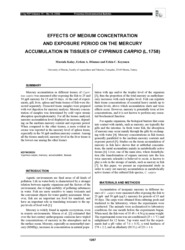
Effects of Medium Concentration and Exposure Period on the Mercury Accumulation in Tissues of Cyrinus carpio L 1758
Ahmet Erdem Dönmez, Cafer Erkin Koyuncu
Mercury accumulation in different tissues of Cyprinus carpio was measured after exposing the fish to 25 and 50 ppb mercury for 15 and 30 days. At the end ofexperiments, gill, liver, spleen and brain tissues of fish were dissected separately. Dissected tissue samples were prepared with wet digestion for mercury analysis. Mercury concentration of samples was determined by cold vapor atomic absorption spectrophotometry. For all the tissues analyzed, mercury accumulation level displayed an increase, depending on the medium mercury content and exposure period. When compared to the other tissues, a more evident increase was reported in the mercury level of spleen tissue, especially in the 50 ppb medium mercury content. Among all the tissues analyzed, mercury level in the liver tissue is the low...
Effects of Lead on Reproduction Physiology and Liver and Gonad Histology of Male Cyprinus carpio
Cengiz Korkmaz, Özcan Ay, Ahmet Erdem Dönmez, Burcu Demirbağ
Sera 17β-estradiol (E2), 11-ketotesteron (11-KT) and 17,20-β-dihydroxy-4-pregnen-3-one (17,20βP) levels and hepatosomatic-gonadosomatic indexes (HSI-GSI) were determined after exposing male C. carpio to 0.13 and 0.26 mg L−1 lead after 7, 14 and 21 days. Histological changes in liver and gonad tissues of male C. carpio were also determined. Sera E2, 11-KT and 17,20βP levels of male fish although showed differences from the control fish, these differences were not statistically significant. This was also true for the HSI values, the GSI values however, decreased on day 7 under the effect of 0.26 mg L−1 Pb. Dilatation in bile duct and sinusoids and lymphocyte infiltration were observed under histopathological examination. Low intensities of fibrosis were detected in testis tissues. Exposure t...