






-
BULLETIN OF THE INTERNATIONAL MATHEMATICAL VIRTUAL INSTITUTE3
-
Journal of Science and Arts3
-
Journal of Contemporary Applied Mathematics2
-
Notes on Number Theory and Discrete Mathematics2
-
ACTA ET COMMENTATIONES UNIVERSITATIS TARTUENSIS DE MATHEMATICA1
-
Acta Universitatis Apulensis1
-
CREAT. MATH. INFORM.1
-
Demonstratio Mathematica1
-
Dicle University Journal of Engineering1
-
Electronic Journal of Mathematical Analysis and Applications1
-
BULLETIN OF THE INTERNATIONAL MATHEMATICAL VIRTUAL INSTITUTE3
-
Ifs And Contemporary Mathematics Conference3
-
Journal of Science and Arts3
-
Journal of Contemporary Applied Mathematics2
-
Notes on Number Theory and Discrete Mathematics2
-
ACTA ET COMMENTATIONES UNIVERSITATIS TARTUENSIS DE MATHEMATICA1
-
Acta Universitatis Apulensis1
-
Aligarh Muslim University1
-
CREAT. MATH. INFORM.1
-
DE GRUYTER1

Bernoulli-Padovan polynomials and Pado-Bernoulli matrices
Dişkaya, Orhan | Menken, Hamza
In the present work we introduce Bernoulli-Padovan numbers and polynomials. We give their generating functions of the Bernoulli-Padovan numbers and polynomials. We establish various relations involving the Bernoulli-Padovan numbers and polynomials by considering the Pado-derivative. We describe Pado-Bernoulli matrices in terms of the Bernoulli-Padovan numbers and polynomials. We establish a factorisation of the Pado- Bernoulli matrix by using a generalised Pado-Pascal matrix, and obtain the inverse of the Pado-Bernoulli matrix. Also, we give a relationship between the Pado-Bernoulli matrix and the Pado-Pascal matrix.
ON THE NOVEL GENERALIZATIONS OF THE PADOVAN SEQUENCE
Dişkaya, Orhan | Menken, Hamza
In the present work, we consider the Padovan sequence and define a sequence (called Quadrovan) that is a new generalization. In addition, we give the previously defined Tridovan sequence as a generalization of the Padovan sequence. We derive the Binet-like formulas, the generating functions and the exponential generating functions for the Tridovan and Quadrovan sequences. Also, we establish their series and matrices.
On the Quinary Fibonacci-Padovan Sequences
Dişkaya, Orhan | Menken, Hamza
In this paper, we consider the Fibonacci and Padovan sequences. We introduce the quinary Fibonacci-Padovan sequences whose compounds are the Fibonacci and Padovan sequences. We derive the Binet-like formulas, the generating functions and exponential generating functions of these sequences. Also, we obtain some binomial identities, series and sums for them.
ON THE PADOVAN ARRAYS
Dişkaya, Orhan | Menken, Hamza
In the present work, two new recurrences of the Padovan sequence given with delayed initial conditions are defined. Some identities of these sequences which we call the Padovan arrays were examined. Also, generating and series functions of the Padovan arrays are examined.

On the bi-periodic Padovan sequences
Dişkaya, Orhan | Menken, Hamza
In this study, we define a new generalization of the Padovan numbers, which shall also be called the bi-periodic Padovan sequence. Also, we consider a generalized bi-periodic Padovan matrix sequence. Finally, we investigate the Binet formulas, generating functions, series and partial sum formulas for these sequences

ON THE RECURRENCES OF THE JACOBSTHAL SEQUENCE
Dişkaya, Orhan | Menken, Hamza
In the present work, two new recurrences of the Jacobsthal sequence are defined. Some identities of these sequences which we call the Jacobsthal array is examined. Also, the generating and series functions of the Jacobsthal array are obtained.
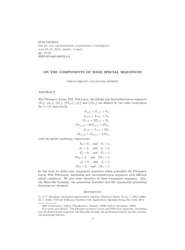
ON THE COMPONENTS OF SOME SPECIAL SEQUENCES
Dişkaya, Orhan | Menken, Hamza
The Fibonacci, Lucas, Pell, Pell-Lucas, Jacobsthal and Jacobsthal-Lucas sequences {Fn}, {Ln}, {Pn}, {P Ln}, {Jn} and {JLn} are defined by two order recurrences for n ≥ 0, respectively, Fn+2 = Fn+1 + Fn, Ln+2 = Ln+1 + Ln, Pn+2 = 2Pn+1 + Pn, P Ln+2 = 2P Ln+1 + P Ln, Jn+2 = Jn+1 + 2Jn, JLn+2 = JLn+1 + 2JLn, with the initial conditions, respectively, F0 = 0, and F1 = 1, L0 = 2, and L1 = 1, P0 = 0, and P1 = 1, P L0 = 2, and P L1 = 1, J0 = 0, and J1 = 1, JL0 = 2, and JL1 = 1. In this work we define new component sequences which generalize the Fibonacci, Lucas, Pell, Pell-Lucas, Jacobsthal and Jacobsthal-Lucas sequences with different initial conditions. We give some identities of these component sequences. Also, the Binet-like formulas, the generating functions and the exponentia...

A NEW GENERALIZATION OF THE PADOVAN SEQUENCE
Dişkaya, Orhan | Menken, Hamza
Integers number sequences in mathematics are one of the subjects with the most ap- plication area. The Fibonacci number sequence has applications in many branches of science such as nature, anatomy, botany, zoology, art, music, analysis, physics, astronomy, chemistry, biology and computers. Since the positive real root of the Fibonacci number sequence gives the golden ratio, it has many applications. Many scientists deal with Fibonacci sequence and its generalizations in recent years. Some of these generalizations are number sequences such as Lucas, Pell, and Jacobthal [4, 5, 6]. In this study, the Padovan numbers sequence, which has a third-order characteristic equation, and some of its generalizations are examined. The Padovan sequence {Pn} is defined by the third order recurren...
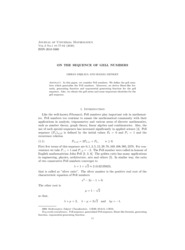
ON THE SEQUENCE OF GELL NUMBERS
Dişkaya, Orhan | Menken, Hamza
In this paper, we consider Pell numbers. We define the gell num- bers which generalize the Pell numbers. Moreover, we derive Binet-like for- mula, generating function and exponential generating function for the gell sequence. Also, we obtain the gell series and some important identities for the gell sequence.
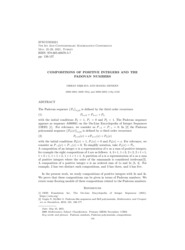
COMPOSITIONS OF POSITIVE INTEGERS AND THE PADOVAN NUMBERS
Dişkaya, Orhan | Menken, Hamza
The Padovan sequence {Pn}n≥0 is defined by the third order recurrence (1) Pn+3 = Pn+1 + Pn with the initial conditions P0 = 1, P1 = 0 and P2 = 1. The Padovan sequence appears as sequence A000931 on the On-Line Encyclopedia of Integer Sequences (OEIS) [1]. For relevance, we consider as P−2 = P−1 = 0. In [2] the Padovan polynomial sequence {Pn(x)}n≥0 is defined by a third order recurrence (2) Pn+3(x) = xPn+1(x) + Pn(x) with the initial conditions P0(x) = 1, P1(x) = 0 and P2(x) = x. For relevance, we consider as P−2(x) = P−1(x) = 0. To simplify notation, take Pn(x) = Pn. A composition of an integer n is a representation of n as a sum of positive integers, for example the eight compositions of 4 are as follows: 4, 3+1, 1+3, 2+2, 2+1+1, 1 + 2 + 1, 1 + 1 + 2, 1 + 1 + 1 + 1. A partition ...
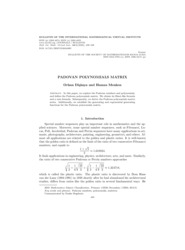
PADOVAN POLYNOMIALS MATRIX
Dişkaya, Orhan | Menken, Hamza
In this paper, we explore the Padovan numbers and polynomials, and define the Padovan polynomials matrix. We obtain its Binet-like formula and a sum formula. Subsequently, we derive the Padovan polynomials matrix series. Additionally, we establish the generating and exponential generating functions for the Padovan polynomials matrix.
On the Pseudo-Fibonacci and Pseudo-Lucas Quaternions
Dişkaya, Orhan | Menken, Hamza
There are a lot of quaternion numbers that are related to theFibonacci and Lucas numbers or their generalizations have been described and extensively explored. The coefficients of these quaternions have been chosen from terms of Fibonacci and Lucas numbers. In this study, we define two new quaternions that are pseudo-Fibonacci and pseudo-Lucas quaternions. Then, we give their Binet-like formulas, generating functions, certain binomial sums and Honsberg-like, d’Ocagne-like, Catalan-like and Cassini-like identities.

Compositions of positive integers with 2s and 3s
Dişkaya, Orhan | Menken, Hamza
In this article, we consider compositions of positive integers with 2s and 3s. We see that these compositions lead us to results that involve Padovan numbers, and we give some tiling models of these composi- tions. Moreover, we examine some tiling models of the compositions related to the Padovan polynomials and prove some identities using the tiling model’s method. Next, we obtain various identities of the compositions of positive integers with 2s and 3s related to the Padovan numbers. The number of palindromic compositions of this type is determined, and some numerical arithmetic functions are defined. Finally, we provide a table that compares all of the results obtained from compositions of positive integers with 2s and 3s.
On the F-Bernstein polynomials
Erdem, Alper | Dişkaya, Orhan | Menken, Hamza
In this present work, we construct a new Bernstein operator which is called the F -Bernstein operator obtained by using F - factorial (Fibonacci factorial) and Fibonomial (Fibonacci binomial). Then we examine the F-Bernstein basis polynomials and some properties. Moreover, we acquire some connection between the F -Bernstein polynomials and the Fibonacci numbers.
ON A GENERALIZATION OF THE HOSOYA TRIANGLE
Menken, Hamza | Dişkaya, Orhan
In this talk, we introduce the Fibonacci polynomial triangle, inspired by the struc- ture of the Hosoya triangle, utilizing Fibonacci polynomials. Additionally, we present and prove several identities and properties associated with the Fibonacci polynomial triangle.

On the Split (s, t)-Padovan and (s, t)-Perrin Quaternions
Dişkaya, Orhan | Menken, Hamza
In this paper we consider the generalization of Padovan and Perrin quaternions. We define the split (s, t)-Padovan and (s, t)- Perrin quaternions which generalize Padovan and Perrin quaternions. We derive the Binet-like formulas for the split (s, t)-Padovan and (s, t)-Perrin quaternions. We establish their generating functions. Also, we obtain certain binomial sums regarding the split (s, t)- Padovan and (s, t)-Perrin quaternions.