-
Fakülteler7
-
Su Ürünleri Fakültesi6
-
Su Ürünleri Mühendisliği Bölümü5
-
Su Ürünleri Yetiştiriciliği Bölümü5
-
Su Ürünleri Mühendisliği Anabilim Dalı5
-
Su Ürünleri Avlama ve İşleme Teknolojisi Bölümü4
-
Su Ürünleri Temel Bilimleri Bölümü4
-
Avlama Teknolojisi Anabilim Dalı4
-
İşleme Teknolojisi Anabilim Dalı4
-
Balıkçılık Temel Bilimleri Anabilim Dalı4





New records of haptophyte species from the Northeastern Mediterranean Sea for algal flora of Turkey.
Eker-Develi, Elif
Chrysochromulina alifera, Chrysochromulina lanceolata, Chrysochromulina parkeae, Haptolina cf. ericina, Umbellosphaera irregularis, Umbellosphaera tenuis, Umbilicosphaera foliosa, Syracosphaera molischii, Rhabdosphaera clavigera var stylifera and Ophiaster formosus were recorded for the first time along the Turkish coasts. Non-calcified haptophyte species Chrysochromulina alifera, C. lanceolata, C. parkeae and H. cf. ericina were observed in live samples since formaldehyde damages cells. Among them only C. alifera could be observed with SEM. Either SEM pictures or light microscope images of other species were presented. Although previously reported along Turkish coasts Syracosphaera pulchra was a coccolithophore species most frequently observed after Emiliania huxleyi in the study area. Sc...
Effects of Diazinon on 17β-estradiol, Plasma Vitellogenin and Liver and Gonad Tissues of Common Carp (Cyprinus carpio, L., 1758)
Korkmaz Cengiz | Dönmez Ahmet Erdem
Both sexes of Common carp (Cyprinus carpio) exposed to sublethal concentrations (0.488 mg/L and 0.976 mg/L) of the widely used insecticide diazinon for a period of 7, 15, 30 days and effects on plasma 17β-estradiol (E2), vitellogenin (VTG), gonad and liver tissues were examined. In male carps, 0.488 mg/L and 0.976 mg/L diazinon elevated E2 levels following on the 7, 15 and 30 days. Both concentrations of diazinon elevated VTG levels after 15 days in males. In female carps, 0.976 mg/L diazinon elevated E2 levels after 30 days. However, 0.488 mg/L and 0.976 mg/L diazinon reduced VTG levels in female carps, at the end of experiment. Histopathological examination of liver showed dilatation of the bile ducts and sinusoids, congestion, lymphocytic infiltration, pigment accumulation and necrosis ...
Partial Replacement of Fish Oil with Vegetable Oils in Diets for EuropeanSeabass (Dicentrarchus labrax): Effects On Growth Performance and FattyAcids Profile
Engin, Kenan
The study was conducted to determine the effects of alternative oil sources on growth, body composition and feed conversion of sea bass individuals. The tested oils used in the study were as follows: sesame oil (SO), canola oil (CO) and soybean oil (SBO). All tested oils were included at a 50% substitution level of fish oil and were compared with a control diet containing 100% fish oil (FO). There was no effect of diet on specific growth rate. The highest final weight was seen in fish fed SO and FO diets compared to that of fish fed CO diet and SBO diets (P0.05). In the n-6 fatty acids, fish fed SBO diet contained significant amount of linoleic acids (LA, 18:2n-6) compared to that of fish other dietary treatments diets . Deposition of eicosapentaenoic acid (EPA, 20:5n-3) and docosahexaenoi...
Effects Of The Feeds Containing Different Plant Protein Sources On Growth Performance And Body Composition Of Rainbow Trout (Oncorhynchus mykiss W )
Bilgüven, Murat | Barış, Mustafa
In this study, a total of 720 rainbow trout (Oncorhyncus mykiss) having 50.08±0.19 g of average initial weight were used to compare of usage of the soybean meal, sunflower meal, canola meal and cottonseed meal as the best plant protein source. Four different feeds which contain soybean meal (SBM), canola meal (CM), sunflower meal (SFM) and cotton seed meal were used, respectively. Four trial groups were tested in triplicate during 12 weeks. Experimental diets were prepared as isonitrogenous significantly difference among the groups for average feed consumption, condition factor and survival rate, however, average (42% CP) and isocaloric (13.9 MJ DE/kg feed). At the end of the study, it was observed that there was no live weight, live weight gain, feed conversion ratio (FCR), protein effici...
Potential of Cottonseed Oil as Fish Oil Replacer in European Sea Bass Feed Formulation
Engin, Kenan
Triplicate groups of 20 European sea bass (35 g) were fed five diets in which the added lipid was 100% fish oil (FO), 40% (CSO40), 60% (CSO60), 80% (CSO80) and 100% (CSO100) refined cottonseed oil (CSO), for a period of 120 days. Overall fish growth, feed conversion ratio and protein utilization were unaffected by dietary treatment, but hepatosomatic and visceral fat indexes increased with increasing dietary CSO. Fillet fatty acid composition of total lipids reflected the fatty acids in the test diets. The monounsaturated fatty acids were significantly higher in fillet of fish fed diet FO, CSO40 and CSO60 compared to other treatments while saturated and polyunsaturated fatty acids (PUFA) were not affected by the dietary treatment. Some fatty acids (18:0, 18:1n-9, 20:5n-3 and 22:6n-3) were ...

Effects of Dietary L-carnitine Supplementation on Growth, Muscle Fatty acid Composition and Economic Profit of Rainbow Trout (Oncorhynchus mykiss)
HUNT, ARZU ÖZLÜER
In this study, the effect of dietary L-carnitine on growth, proximate and muscle fatty acid compositions of rainbow trout (Oncorhynchus mykiss) were investigated. The fish were fed with diets containing 300 mg kg-1 L-carnitine (LC300), other group was fed with diets containing 600 mg kg-1 L-carnitine (LC600) and control group was not supplementary L-carnitine for 63 days. The weight gain of LC600 fed with L-carnitine supplemented was found to be 7.73% higher than in control group. Feed conversion ratio in LC600 (1.66) and LC300 (1.60) is better than in control group (2.00). L-carnitine supplemented groups would be lower cost of production than control. Economic conversion ratio (ECR) of LC300 (2.71 US.$ kg-1) would represent a saving of 0.44 US.$ kg-1 compared to the control. L-carni...
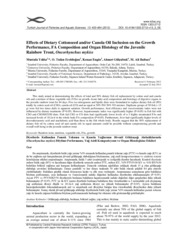
Effects of Dietary Cottonseed and/or Canola Oil Inclusion on the Growth Performance, FA Composition and Organ Histology of the Juvenile Rainbow Trout, Oncorhynchus mykiss
Engin, Kenan
This study aimed at demonstrating the effects of total and 50% dietary fish oil replacement by cotton seed and canola oils and a mixture of these vegetable oils (VOs) on growth, tissue fatty acid composition and histology of digestive organs in the juvenile rainbow trout for 84 days. Five iso-nitrogenous and lipidic diets were formulated to replace dietary fish oil (FO) totally by cotton seed oil (CSO), canola oil (CO) and an equal or 50% FO/ 50% VO mixture. Duplicate groups of 50 fish (~15 g) were fed two times daily to apparent satiation. Growth performance, feed efficiency and viscerosomatic index were not influenced by dietary treatments (P>0.05). However, hepatosomatic index was significantly higher (P