Determination of Effects of Seasonal and Sampling Area on Ulva Rigida’s Elemental Composition
- Görüntülenme 51
- İndirme 0
-
 Google Akademik




|
Eser Adı dc.title |
Determination of Effects of Seasonal and Sampling Area on Ulva Rigida’s Elemental Composition |
|---|---|
|
Yazarlar dc.contributor.author |
Alp, Mehmet Tahir |
|
Yazarlar dc.contributor.author |
Börekçi, Nahit Soner |
|
Yazarlar dc.contributor.author |
Ayas, Deniz |
|
Kurum Dışı Yazarlar dc.contributor.other |
MISRA BAKAR |
|
Kurum Dışı Yazarlar dc.contributor.other |
BÜŞRA PEKSEZER |
|
Yayıncı dc.publisher |
Mersin Üniversitesi |
|
Yayın Türü dc.type |
Makale |
|
Özet dc.description.abstract |
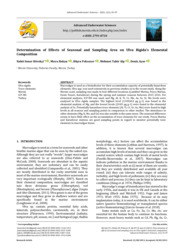
Macroalgae is used as a bioindicator for their accumulation capacity of potentially hazardous elements. Ulva spp. was used extensively in previous studies as in the recent study. Along the Mersin coast, sampling was made in four different locations (Çamlıbel Marina, Pozcu Marina, Deniz Feneri, Karaduvar) during the spring and summer seasons between 2015-2016. For elemental analyses, ICP-MS was used, and Mg, Al, K, Ti, Cr, Mn, As, Se, Sr, Mo levels were analyzed in Ulva rigidasamples. The highest level (134960.0 μg g-1) was found in the elemental analysis of Mg, and the lowest levels (20.83 μg g-1) were found in the elemental analysis of Se. Potentially hazardous trace elements (Al, Ti, Cr, Sr, As, Mn) were found in high levels in all seasons and sampling points in comparison to other studies. The abundance in other elements (Mg, K, Mo, and Se) was also notable in the same sense. The seasonal difference seems to have little effect on the accumulation of trace elements for our study. Pozcu Marina and Karaduvar stations are good sampling points in regard to monitor potentially toxic elements in macroalgae tissue. |
|
Kayıt Giriş Tarihi dc.date.accessioned |
2024-03-29 |
|
Yayın Yılı dc.date.issued |
2021 |
|
Açık Erișim Tarihi dc.date.available |
2024-03-29 |
|
Dil dc.language.iso |
eng |
|
Konu Başlıkları dc.subject |
Ulva rigida |
|
Konu Başlıkları dc.subject |
Trace Elements |
|
Konu Başlıkları dc.subject |
Mersin |
|
Konu Başlıkları dc.subject |
ICP-MS |
|
Atıf İçin Künye dc.identifier.citation |
Börekçi NS, Bakan M, Peksezer B, Alp M T & Ayas D(2021). Determination of effects of seasonal and sampling area on Ulva rigida’s elemental composition.Advanced Underwater Sciences, 1(1), 01-07 |
|
ISSN dc.identifier.issn |
2791-8734 |
|
İlk Sayfa dc.identifier.startpage |
1 |
|
Son Sayfa dc.identifier.endpage |
7 |
|
Makale Numarası dc.identifier.articlenumber |
- |
|
Dergi Adı dc.relation.journal |
Advanced Underwater Sciences |
|
Dergi Sayısı dc.identifier.issue |
1 |
|
Dergi Cilt dc.identifier.volume |
1 |
|
Tek Biçim Adres (URI) dc.identifier.uri |
https://hdl.handle.net/20.500.14114/5930 |
|
İndekslenen Platformlar dc.source.database |
Dergi Park |
Creative Commons Lisansı
|

|