The relationship between perceived social support and depression level of patients with diabetic foot
- Görüntülenme 4
- İndirme 0
-
 Google Akademik
-
 DOI
DOI

| Yazarlar | Yıldız Karadeniz Ebru |
| Kurum Dışı Yazarlar | Aştı Türkinaz |
| Tek Biçim Adres (URI) | https://hdl.handle.net/20.500.14114/8117 |
| Yayın Türü | Makale |
| Yayın Yılı | 2015 |
| DOI Adresi | 10.1186/s40200-015-0168-8 |
| Yayıncı | J Diabetes Metab Disord |
| Dergi Adı | J Diabetes Metab Disord |
| Konu Başlıkları | diabetes mellitus Diabetic Foot Depression Social support |
| İndekslenen Platformlar | Web of Science |
Background
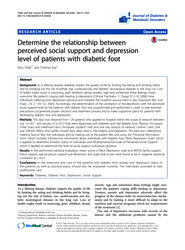
As a lifelong disease, diabetes impairs the quality of life by limiting the eating and drinking habits and by bringing out the risk of kidney, eye, cardiovascular and diabetic neurological diseases in the long run. Loss of health might result in mourning, grief, rebellion, denial, anxiety, rage and sometimes these feelings might overcome the patient’s coping skills leading to depression [Clinical Psychiatry 11 (Suppl 3) 3-18, 2008]. How individuals suffering from depression perceive and interpret the incidents around them is also important [Rel. Scie. Acad. J. III, 2: 129-152, 2003]. Accordingly, the determination of the correlation of the depression with the perceived social support level by the patients with diabetic foot was programmed and performed in order to take essential precautions, to generate proper solutions and treatment process and to make supportive plans for patients with developing diabetic foot and depression.
Methods
The data was obtained from 128 patients who applied to hospital within the scope of research between July 1st 2011 and January 31st 2012 that were diagnosed with diabetes and had diabetic foot. Pearson chi-square, Fisher Exact and Likelihood ratio, chi-square, Student t test and one way analysis of variance, Levene’ s test, One way ANOVA, Welch and Games Howell tests were used in the analysis and evaluation. The data was collected by meeting face to face the individuals and by making use of the patient files and using the “Personal Information Form” which includes introductory information about individuals with diabetic foot, “Beck Depression Scale” which is applied to determine emotion status of individuals and “Multidimensional Scale of Perceived Social Support” which is applied to determine the level of social support individuals perceive.
Results
In the performed statistical evaluation, mean scores of Beck Depression scale and MSPSS family support, friend support, special person support sub-dimension and scale total scores were found to be in negative statistical correlation (p < 0.01).
Conclusions
In the treatment and care of the patients with diabetic foot; anxiety and depression status of the patients, as well as physical status, should also be evaluated routinely. The individuals provided to take professional care.
Background
As a lifelong disease, diabetes impairs the quality of life by limiting the eating and drinking habits and by bringing out the risk of kidney, eye, cardiovascular and diabetic neurological diseases in the long run. Loss of health might result in mourning, grief, rebellion, denial, anxiety, rage and sometimes these feelings might overcome the patient’s coping skills leading to depression [Clinical Psychiatry 11 (Suppl 3) 3-18, 2008]. How individuals suffering from depression perceive and interpret the incidents around them is also important [Rel. Scie. Acad. J. III, 2: 129-152, 2003]. Accordingly, the determination of the correlation of the depression with the perceived social support level by the patients with diabetic foot was programmed and performed in order to take essential precautions, to generate proper solutions and treatment process and to make supportive plans for patients with developing diabetic foot and depression.
Methods
The data was obtained from 128 patients who applied to hospital within the scope of research between July 1st 2011 and January 31st 2012 that were diagnosed with diabetes and had diabetic foot. Pearson chi-square, Fisher Exact and Likelihood ratio, chi-square, Student t test and one way analysis of variance, Levene’ s test, One way ANOVA, Welch and Games Howell tests were used in the analysis and evaluation. The data was collected by meeting face to face the individuals and by making use of the patient files and using the “Personal Information Form” which includes introductory information about individuals with diabetic foot, “Beck Depression Scale” which is applied to determine emotion status of individuals and “Multidimensional Scale of Perceived Social Support” which is applied to determine the level of social support individuals perceive.
Results
In the performed statistical evaluation, mean scores of Beck Depression scale and MSPSS family support, friend support, special person support sub-dimension and scale total scores were found to be in negative statistical correlation (p < 0.01).
Conclusions
In the treatment and care of the patients with diabetic foot; anxiety and depression status of the patients, as well as physical status, should also be evaluated routinely. The individuals provided to take professional care.
- Fakülteler
- Hemşirelik Fakültesi
- Hemşirelik Esasları Anabilim Dalı
|
Eser Adı dc.title |
Determine the relationship between perceived social support and depression level of patients with diabetic foot |
|---|---|
|
Eser Adı dc.title |
The relationship between perceived social support and depression level of patients with diabetic foot |
|
Yazarlar dc.contributor.author |
Yıldız Karadeniz Ebru |
|
Kurum Dışı Yazarlar dc.contributor.other |
Aştı Türkinaz |
|
Yayıncı dc.publisher |
J Diabetes Metab Disord |
|
Yayın Türü dc.type |
Makale |
|
Özet dc.description.abstract |
Background As a lifelong disease, diabetes impairs the quality of life by limiting the eating and drinking habits and by bringing out the risk of kidney, eye, cardiovascular and diabetic neurological diseases in the long run. Loss of health might result in mourning, grief, rebellion, denial, anxiety, rage and sometimes these feelings might overcome the patient’s coping skills leading to depression [Clinical Psychiatry 11 (Suppl 3) 3-18, 2008]. How individuals suffering from depression perceive and interpret the incidents around them is also important [Rel. Scie. Acad. J. III, 2: 129-152, 2003]. Accordingly, the determination of the correlation of the depression with the perceived social support level by the patients with diabetic foot was programmed and performed in order to take essential precautions, to generate proper solutions and treatment process and to make supportive plans for patients with developing diabetic foot and depression. Methods The data was obtained from 128 patients who applied to hospital within the scope of research between July 1st 2011 and January 31st 2012 that were diagnosed with diabetes and had diabetic foot. Pearson chi-square, Fisher Exact and Likelihood ratio, chi-square, Student t test and one way analysis of variance, Levene’ s test, One way ANOVA, Welch and Games Howell tests were used in the analysis and evaluation. The data was collected by meeting face to face the individuals and by making use of the patient files and using the “Personal Information Form” which includes introductory information about individuals with diabetic foot, “Beck Depression Scale” which is applied to determine emotion status of individuals and “Multidimensional Scale of Perceived Social Support” which is applied to determine the level of social support individuals perceive. Results In the performed statistical evaluation, mean scores of Beck Depression scale and MSPSS family support, friend support, special person support sub-dimension and scale total scores were found to be in negative statistical correlation (p < 0.01). Conclusions In the treatment and care of the patients with diabetic foot; anxiety and depression status of the patients, as well as physical status, should also be evaluated routinely. The individuals provided to take professional care. |
|
Özet dc.description.abstract |
Background As a lifelong disease, diabetes impairs the quality of life by limiting the eating and drinking habits and by bringing out the risk of kidney, eye, cardiovascular and diabetic neurological diseases in the long run. Loss of health might result in mourning, grief, rebellion, denial, anxiety, rage and sometimes these feelings might overcome the patient’s coping skills leading to depression [Clinical Psychiatry 11 (Suppl 3) 3-18, 2008]. How individuals suffering from depression perceive and interpret the incidents around them is also important [Rel. Scie. Acad. J. III, 2: 129-152, 2003]. Accordingly, the determination of the correlation of the depression with the perceived social support level by the patients with diabetic foot was programmed and performed in order to take essential precautions, to generate proper solutions and treatment process and to make supportive plans for patients with developing diabetic foot and depression. Methods The data was obtained from 128 patients who applied to hospital within the scope of research between July 1st 2011 and January 31st 2012 that were diagnosed with diabetes and had diabetic foot. Pearson chi-square, Fisher Exact and Likelihood ratio, chi-square, Student t test and one way analysis of variance, Levene’ s test, One way ANOVA, Welch and Games Howell tests were used in the analysis and evaluation. The data was collected by meeting face to face the individuals and by making use of the patient files and using the “Personal Information Form” which includes introductory information about individuals with diabetic foot, “Beck Depression Scale” which is applied to determine emotion status of individuals and “Multidimensional Scale of Perceived Social Support” which is applied to determine the level of social support individuals perceive. Results In the performed statistical evaluation, mean scores of Beck Depression scale and MSPSS family support, friend support, special person support sub-dimension and scale total scores were found to be in negative statistical correlation (p < 0.01). Conclusions In the treatment and care of the patients with diabetic foot; anxiety and depression status of the patients, as well as physical status, should also be evaluated routinely. The individuals provided to take professional care. |
|
Kayıt Giriş Tarihi dc.date.accessioned |
2025-12-26 |
|
Yayın Yılı dc.date.issued |
2015 |
|
Açık Erișim Tarihi dc.date.available |
2025-12-26 |
|
Dil dc.language.iso |
eng |
|
Konu Başlıkları dc.subject |
diabetes mellitus |
|
Konu Başlıkları dc.subject |
Diabetic Foot |
|
Konu Başlıkları dc.subject |
Depression |
|
Konu Başlıkları dc.subject |
Social support |
|
Atıf İçin Künye dc.identifier.citation |
Yildiz, E., Aşti, T. Determine the relationship between perceived social support and depression level of patients with diabetic foot. J Diabetes Metab Disord 14, 59 (2015) |
|
ISSN dc.identifier.issn |
2251-6581 |
|
İlk Sayfa dc.identifier.startpage |
1 |
|
Son Sayfa dc.identifier.endpage |
8 |
|
Dergi Adı dc.relation.journal |
J Diabetes Metab Disord |
|
Dergi Sayısı dc.identifier.issue |
14 |
|
Dergi Cilt dc.identifier.volume |
59 |
|
Tek Biçim Adres (URI) dc.identifier.uri |
https://hdl.handle.net/20.500.14114/8117 |
|
DOI Numarası dc.identifier.doi |
10.1186/s40200-015-0168-8 |
|
İndekslenen Platformlar dc.source.database |
Web of Science |
-
PDF