- Görüntülenme 3
- İndirme 0
-
 Google Akademik
-
 DOI
DOI

| Yazarlar | Öncü Emine Köksoy Vayısoğlu Sümbüle Lafcı Diğdem Yıldız Ebru |
| Tek Biçim Adres (URI) | https://hdl.handle.net/20.500.14114/9124 |
| Yayın Türü | Makale |
| Yayın Yılı | 2018 |
| DOI Adresi | 10.1016/j.nedt.2018.02.027 |
| Yayıncı | Elsevier Science |
| Dergi Adı | Nurse Education Today |
| Konu Başlıkları | Alcohol-based hand rub Hand hygiene compliance Nursing student Hand washing |
| İndekslenen Platformlar | Web of Science |
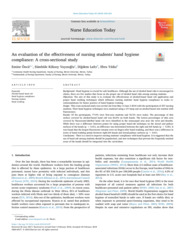
Abstract
Background
Hand hygiene is crucial for safe healthcare. Although the use of alcohol hand rubs is encouraged in clinics, there are few studies that focus on the proper use of alcohol hand rubs among nursing students.
Objectives
The aim of this study is to evaluate the effectiveness of alcohol-based hand rub application and proper hand washing techniques which influence nursing students' hand hygiene compliance to make recommendations for future practice of hand hygiene training.
Design
This cross-sectional study was carried out from May 3/June 3 2016 with the participation of 257 nursing students. Their hand hygiene techniques were analyzed using a UV lamp and an alcohol-based mix marked with fluorescence.
Results
Of the participants, 77.0% were first-year students and 55.3% were males. The percentage of skin surface covered by alcohol-based hand rub was 82.0% on both hands. The lowest percentages of skin area covered by fluorescent-labelled hand rub were identified in the metacarpal area near the wrist and thumbs. While there was a difference between points for using proper hand-rub technique on the dorsal and palmar surfaces of the hands (p < 0.01), no difference was determined between the right and left hands (p > 0.05). It was found that the largest fluorescent remains were on fingers after hand-washing, and there was a difference in terms of hand-washing points between right-left hands and dorsal-palmar surfaces (p < 0.01).
Conclusions
There is a need to improve nursing students' compliance with hand hygiene. It is suggested that the use of hand-rub among students should be popularized, and new techniques that prevent the frequently omitted areas of the hands should be integrated into the curriculum.
- Fakülteler
- Hemşirelik Fakültesi
- Hemşirelik Esasları Anabilim Dalı
|
Eser Adı dc.title |
An evaluation of the effectiveness of nursing students' hand hygiene compliance: A cross-sectional study |
|---|---|
|
Yazarlar dc.contributor.author |
Öncü Emine |
|
Yazarlar dc.contributor.author |
Köksoy Vayısoğlu Sümbüle |
|
Yazarlar dc.contributor.author |
Lafcı Diğdem |
|
Yazarlar dc.contributor.author |
Yıldız Ebru |
|
Yayıncı dc.publisher |
Elsevier Science |
|
Yayın Türü dc.type |
Makale |
|
Özet dc.description.abstract |
Abstract Background Hand hygiene is crucial for safe healthcare. Although the use of alcohol hand rubs is encouraged in clinics, there are few studies that focus on the proper use of alcohol hand rubs among nursing students. Objectives The aim of this study is to evaluate the effectiveness of alcohol-based hand rub application and proper hand washing techniques which influence nursing students' hand hygiene compliance to make recommendations for future practice of hand hygiene training. Design This cross-sectional study was carried out from May 3/June 3 2016 with the participation of 257 nursing students. Their hand hygiene techniques were analyzed using a UV lamp and an alcohol-based mix marked with fluorescence. Results Of the participants, 77.0% were first-year students and 55.3% were males. The percentage of skin surface covered by alcohol-based hand rub was 82.0% on both hands. The lowest percentages of skin area covered by fluorescent-labelled hand rub were identified in the metacarpal area near the wrist and thumbs. While there was a difference between points for using proper hand-rub technique on the dorsal and palmar surfaces of the hands (p < 0.01), no difference was determined between the right and left hands (p > 0.05). It was found that the largest fluorescent remains were on fingers after hand-washing, and there was a difference in terms of hand-washing points between right-left hands and dorsal-palmar surfaces (p < 0.01). Conclusions There is a need to improve nursing students' compliance with hand hygiene. It is suggested that the use of hand-rub among students should be popularized, and new techniques that prevent the frequently omitted areas of the hands should be integrated into the curriculum. |
|
Kayıt Giriş Tarihi dc.date.accessioned |
2025-12-26 |
|
Yayın Yılı dc.date.issued |
2018 |
|
Açık Erișim Tarihi dc.date.available |
2025-12-26 |
|
Dil dc.language.iso |
eng |
|
Konu Başlıkları dc.subject |
Alcohol-based hand rub |
|
Konu Başlıkları dc.subject |
Hand hygiene compliance |
|
Konu Başlıkları dc.subject |
Nursing student |
|
Konu Başlıkları dc.subject |
Hand washing |
|
Atıf İçin Künye dc.identifier.citation |
Öncü, E., Vayısoğlu, S. K., Lafcı, D., & Yıldız, E. (2018). An evaluation of the effectiveness of nursing students' hand hygiene compliance: A cross-sectional study. Nurse education today, 65, 218-224. |
|
ISSN dc.identifier.issn |
1532-2793 |
|
İlk Sayfa dc.identifier.startpage |
218 |
|
Son Sayfa dc.identifier.endpage |
224 |
|
Dergi Adı dc.relation.journal |
Nurse Education Today |
|
Dergi Sayısı dc.identifier.issue |
65 |
|
Dergi Cilt dc.identifier.volume |
June |
|
Tek Biçim Adres (URI) dc.identifier.uri |
https://hdl.handle.net/20.500.14114/9124 |
|
DOI Numarası dc.identifier.doi |
10.1016/j.nedt.2018.02.027 |
|
İndekslenen Platformlar dc.source.database |
Web of Science |
-
PDF