- Görüntülenme 4
- İndirme 0
-
 Google Akademik
-
 DOI
DOI

| Yazarlar | Muhammet Fatih Adıgüzel |
| Yayın Türü | Makale |
| Yayın Yılı | 2023 |
| DOI Adresi | https://doi.org/10.1016/j.pragma.2023.05.005 |
| Yayıncı | Elsevier B.V |
| Dergi Adı | Journal of Pragmatics |
| Konu Başlıkları | discourse analysis discourse particles pragmatic markers |
| İndekslenen Platformlar | Web of Science |
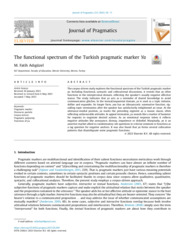
The corpus-driven studyexplores the functional spectrum of the Turkish pragmatic marker ya. Including functional, syntactic and collocational discussions, it reveals that ya often functions in the interpersonal domain, reflecting the speaker's usually negative affective stance. The study indicates that ya acts as a reminder of shared knowledge to avoid communication glitches. In the textual/sequential domain, ya is used as a topic initiator, shifter and expander. Its longer form, yaa has an idiosyncratic summative function, signalling topic termination after the speaker has satisfactorily enlightened an issue. At the utterance-medial position, ya marks the preceding segment as a reason clause, often reflecting unfavourable attitudes. In appeal intonation, ya sounds like a marker of hastener for requests to negotiate desired actions. As an emotional response token it reflects negative attitudes like annoyance, dismay, impatience or disbelief. Marginally, ya is an assertive marker allied to condemnatory wh-questions to criticise someone or functions as a tag question for negative anchors. It was also found that ya forms several collocation patterns that disambiguate some pragmatic functions.
- Fakülteler
- Enstitüler
- Eğitim Bilimleri Enstitüsü
- Yabancı Diller Eğitimi Anabilim Dalı
|
Eser Adı dc.title |
The functional spectrum of the Turkish pragmatic marker Ya |
|---|---|
|
Yazarlar dc.contributor.author |
Muhammet Fatih Adıgüzel |
|
Yayıncı dc.publisher |
Elsevier B.V |
|
Yayın Türü dc.type |
Makale |
|
Özet dc.description.abstract |
The corpus-driven studyexplores the functional spectrum of the Turkish pragmatic marker ya. Including functional, syntactic and collocational discussions, it reveals that ya often functions in the interpersonal domain, reflecting the speaker's usually negative affective stance. The study indicates that ya acts as a reminder of shared knowledge to avoid communication glitches. In the textual/sequential domain, ya is used as a topic initiator, shifter and expander. Its longer form, yaa has an idiosyncratic summative function, signalling topic termination after the speaker has satisfactorily enlightened an issue. At the utterance-medial position, ya marks the preceding segment as a reason clause, often reflecting unfavourable attitudes. In appeal intonation, ya sounds like a marker of hastener for requests to negotiate desired actions. As an emotional response token it reflects negative attitudes like annoyance, dismay, impatience or disbelief. Marginally, ya is an assertive marker allied to condemnatory wh-questions to criticise someone or functions as a tag question for negative anchors. It was also found that ya forms several collocation patterns that disambiguate some pragmatic functions. |
|
Kayıt Giriş Tarihi dc.date.accessioned |
2026-01-02 |
|
Yayın Yılı dc.date.issued |
2023 |
|
Açık Erișim Tarihi dc.date.available |
2026-01-06 |
|
Dil dc.language.iso |
eng |
|
Konu Başlıkları dc.subject |
discourse analysis |
|
Konu Başlıkları dc.subject |
discourse particles |
|
Konu Başlıkları dc.subject |
pragmatic markers |
|
Atıf İçin Künye dc.identifier.citation |
Adıgüzel, M. F. (2015). Semantic and pragmatic analysis of the Turkish discourse particle hele: A corpus-driven study in lexical profiling. Mersin Üniversitesi Dil ve Edebiyat Dergisi, 12(1), 63-92. 37-60 |
|
ISSN dc.identifier.issn |
0378-2166 |
|
İlk Sayfa dc.identifier.startpage |
58 |
|
Son Sayfa dc.identifier.endpage |
71 |
|
Dergi Adı dc.relation.journal |
Journal of Pragmatics |
|
Dergi Sayısı dc.identifier.issue |
212 |
|
Dergi Cilt dc.identifier.volume |
2 |
|
DOI Numarası dc.identifier.doi |
https://doi.org/10.1016/j.pragma.2023.05.005 |
|
İndekslenen Platformlar dc.source.database |
Web of Science |
-
PDF