- Görüntülenme 3
- İndirme 0
-
 Google Akademik
-
 DOI
DOI
| Yazarlar | Eker-Develi, Elif Tekdal, Dilek |
| Kurum Dışı Yazarlar | Merve Konucu Erik Meers Marcella Fernandes de Souza |
| Tek Biçim Adres (URI) | https://hdl.handle.net/20.500.14114/9344 |
| Yayın Türü | Makale |
| Yayın Yılı | 2022 |
| DOI Adresi | https://doi.org/10.3390/app122412968 |
| Yayıncı | MDPI |
| Dergi Adı | Applied sciences |
| Konu Başlıkları | Moringa oleifera bioflocculation; harvest microalgae biomass composition trace elements |
| İndekslenen Platformlar | Web of Science |
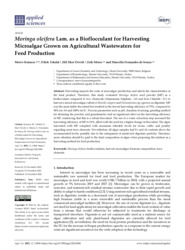
Harvesting impacts the costs of microalgae production and affects the characteristics of
the final product. Therefore, this study evaluated Moringa oleifera seed powder (MP) as a
bioflocculant compared to two chemicals (Aluminium Sulphate—AS and Iron Chloride—IC) to
harvest a mixed microalgae culture (Chlorella vulgaris and Desmodesmus sp.) grown on digestate. MP
was the most stable flocculant but resulted in the lowest harvesting efficiency of 75%, compared to
94% for AS and 100% for IC. Process parameters such as pH, duration of mixing, grinding method
for obtaining the powder, and granulometry had no significant effect on the harvesting efficiency
of MP, reinforcing that this is a robust flocculant. The use of a water extraction step increased the
harvesting efficiency of MP to 91%, albeit with the need for a higher dosage of flocculant. The algae
harvested with MP complied with maximum tolerable levels for swine, cattle, and poultry
regarding most trace elements. Nevertheless, all algae samples had Fe and Al contents above the
recommended levels, possibly due to the entrapment of metal‐rich digestate particles. Therefore,
more attention should be paid to the final composition of algae when proposing flocculation as a
harvesting method for feed production.
- Fakülteler
- Eğitim Fakültesi
- Matematik ve Fen Bilimleri Eğitimi Bölümü
- Fen Bilgisi Eğitimi Anabilim Dalı
|
Eser Adı dc.title |
Moringa oleifera Lam. as a bioflocculant for harvesting microalgae grown on agricultural wastewaters for feed production |
|---|---|
|
Yazarlar dc.contributor.author |
Eker-Develi, Elif |
|
Yazarlar dc.contributor.author |
Tekdal, Dilek |
|
Kurum Dışı Yazarlar dc.contributor.other |
Merve Konucu |
|
Kurum Dışı Yazarlar dc.contributor.other |
Erik Meers |
|
Kurum Dışı Yazarlar dc.contributor.other |
Marcella Fernandes de Souza |
|
Yayıncı dc.publisher |
MDPI |
|
Yayın Türü dc.type |
Makale |
|
Özet dc.description.abstract |
Harvesting impacts the costs of microalgae production and affects the characteristics of the final product. Therefore, this study evaluated Moringa oleifera seed powder (MP) as a bioflocculant compared to two chemicals (Aluminium Sulphate—AS and Iron Chloride—IC) to harvest a mixed microalgae culture (Chlorella vulgaris and Desmodesmus sp.) grown on digestate. MP was the most stable flocculant but resulted in the lowest harvesting efficiency of 75%, compared to 94% for AS and 100% for IC. Process parameters such as pH, duration of mixing, grinding method for obtaining the powder, and granulometry had no significant effect on the harvesting efficiency of MP, reinforcing that this is a robust flocculant. The use of a water extraction step increased the harvesting efficiency of MP to 91%, albeit with the need for a higher dosage of flocculant. The algae harvested with MP complied with maximum tolerable levels for swine, cattle, and poultry regarding most trace elements. Nevertheless, all algae samples had Fe and Al contents above the recommended levels, possibly due to the entrapment of metal‐rich digestate particles. Therefore, more attention should be paid to the final composition of algae when proposing flocculation as a harvesting method for feed production. |
|
Kayıt Giriş Tarihi dc.date.accessioned |
2026-01-22 |
|
Yayın Yılı dc.date.issued |
2022 |
|
Açık Erișim Tarihi dc.date.available |
2026-01-22 |
|
Dil dc.language.iso |
eng |
|
Konu Başlıkları dc.subject |
Moringa oleifera |
|
Konu Başlıkları dc.subject |
bioflocculation; harvest |
|
Konu Başlıkları dc.subject |
microalgae |
|
Konu Başlıkları dc.subject |
biomass composition |
|
Konu Başlıkları dc.subject |
trace elements |
|
Atıf İçin Künye dc.identifier.citation |
Konucu, M., Tekdal, D., Eker-Develi, E., Meers, E., Fernandes, de Souza, M. 2022. Moringa oleifera Lam. as a bioflocculant for harvesting microalgae grown on agricultural wastewaters for feed production. Applied Sciences, 12, 12968. https://doi.org/10.3390/app122412968 |
|
Haklar dc.rights |
MDPI |
|
ISSN dc.identifier.issn |
2076-3417 |
|
İlk Sayfa dc.identifier.startpage |
1 |
|
Son Sayfa dc.identifier.endpage |
14 |
|
Makale Numarası dc.identifier.articlenumber |
12968 |
|
Dergi Adı dc.relation.journal |
Applied sciences |
|
Dergi Sayısı dc.identifier.issue |
1 |
|
Dergi Cilt dc.identifier.volume |
12 |
|
Tek Biçim Adres (URI) dc.identifier.uri |
https://hdl.handle.net/20.500.14114/9344 |
|
DOI Numarası dc.identifier.doi |
https://doi.org/10.3390/app122412968 |
|
İndekslenen Platformlar dc.source.database |
Web of Science |
-
PDF