- Görüntülenme 3
- İndirme 0
-
 Google Akademik


| Yazarlar | Dişkaya, Orhan Menken, Hamza |
| Tek Biçim Adres (URI) | https://hdl.handle.net/20.500.14114/9558 |
| Yayın Türü | Bildiri |
| Yayın Yılı | 2021 |
| Yayıncı | Ifs And Contemporary Mathematics Conference |
| Editör / Editörler | Çuvalcıoğlu, Gökhan |
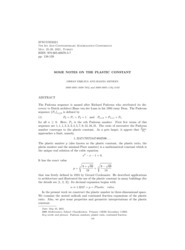
The Padovan sequence is named after Richard Padovan who attributed its dis-
covery to Dutch architect Hans van der Laan in his 1994 essay Dom. The Padovan
sequence {Pn}n≥0 is defined by
(1) P0 = P1 = P2 = 1 and Pn+3 = Pn+1 + Pn
for all n ≥ 0. Here, Pn is the nth Padovan number. First few terms of this
sequence are 1, 1, 1, 2, 2, 3, 4, 5, 7, 9, 12, 16, 21. The ratio of successive the Padovan
number converges to the plastic constant. As n gets larger, it appers that PPn+1
n
approaches a limit, namely,
1, 32471795724474602596 . . .
The plastic number p (also known as the plastic constant, the plastic ratio, the
platin number and the minimal Pisot number) is a mathematical constant which is
the unique real solution of the cubic equation
x3 − x − 1 = 0.
It has the exact value
p = s3 9 +
√
69
18 +
s3 9 −
√
69
18
that was firstly defined in 1924 by Gerard Cordonnier. He described applications
to architecture and illustrated the use of the plastic constant in many buildings (for
the details see [1, 2, 3]). Its decimal expansion begins with
α ≈ 1.3247 = p = P lastic ratio.
In the present work we construct the plastic number in three-dimensional space.
We examine the nested radicals and continued fraction expansions of the plastic
ratio. Also, we give some properties and geometric interpretations of the plastic
constant.
- Fakülteler
- Fen Fakültesi
- Matematik Bölümü
- Cebir Sayıları Teorisi Anabilim Dalı
|
Eser Adı dc.title |
SOME NOTES ON THE PLASTIC CONSTANT |
|---|---|
|
Özet dc.description.abstract |
The Padovan sequence is named after Richard Padovan who attributed its dis- covery to Dutch architect Hans van der Laan in his 1994 essay Dom. The Padovan sequence {Pn}n≥0 is defined by (1) P0 = P1 = P2 = 1 and Pn+3 = Pn+1 + Pn for all n ≥ 0. Here, Pn is the nth Padovan number. First few terms of this sequence are 1, 1, 1, 2, 2, 3, 4, 5, 7, 9, 12, 16, 21. The ratio of successive the Padovan number converges to the plastic constant. As n gets larger, it appers that PPn+1 n approaches a limit, namely, 1, 32471795724474602596 . . . The plastic number p (also known as the plastic constant, the plastic ratio, the platin number and the minimal Pisot number) is a mathematical constant which is the unique real solution of the cubic equation x3 − x − 1 = 0. It has the exact value p = s3 9 + √ 69 18 + s3 9 − √ 69 18 that was firstly defined in 1924 by Gerard Cordonnier. He described applications to architecture and illustrated the use of the plastic constant in many buildings (for the details see [1, 2, 3]). Its decimal expansion begins with α ≈ 1.3247 = p = P lastic ratio. In the present work we construct the plastic number in three-dimensional space. We examine the nested radicals and continued fraction expansions of the plastic ratio. Also, we give some properties and geometric interpretations of the plastic constant. |
|
Yazarlar dc.contributor.author |
Dişkaya, Orhan |
|
Yazarlar dc.contributor.author |
Menken, Hamza |
|
Yayıncı dc.publisher |
Ifs And Contemporary Mathematics Conference |
|
Yayın Türü dc.type |
Bildiri |
|
Kayıt Giriş Tarihi dc.date.accessioned |
2021-05-25 |
|
Tek Biçim Adres (URI) dc.identifier.uri |
https://hdl.handle.net/20.500.14114/9558 |
|
Dil dc.language.iso |
eng |
|
İlk Sayfa dc.identifier.startpage |
138 |
|
Son Sayfa dc.identifier.endpage |
139 |
|
Açık Erișim Tarihi dc.date.available |
2021-05-29 |
|
Yayın Yılı dc.date.issued |
2021 |
-
PDF