- Görüntülenme 3
- İndirme 0
-
 Google Akademik
| Yazarlar | Tezol,Özlem Karahan,Feryal Unal,Selma |
| Tek Biçim Adres (URI) | https://hdl.handle.net/20.500.14114/9782 |
| Yayın Türü | Makale |
| Yayın Yılı | 2021 |
| DOI Adresi | https://www.ncbi.nlm.nih.gov/pmc/articles/PMC8655956/pdf/tap- |
| Yayıncı | Türk Pediatri Kurumu |
| Dergi Adı | Turk Arch Pediatr |
| Konu Başlıkları | Sickle cell disease, psychosocial well-being, avascular necrosis |
| İndekslenen Platformlar | PubMed |
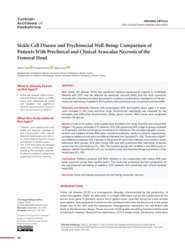
Aim: Sickle cell disease (SCD) has significant adverse psychosocial impacts in childhood. Patients with SCD may be affected by avascular necrosis (AVN) and the most commonly involved site is the femoral head. We aimed to conduct a comparative investigation of the psychosocial well-being of pediatric SCD patients with preclinical and clinical femoral head AVN. Materials and Methods: Patients with homozygous SCD and healthy peers aged 7-17 years were included in this cross-sectional study. Psychosocial well-being was assessed by the Strengths and Difficulties Questionnaire (SDQ), parent version. SDQ scores were compared between the groups.
Results: A total of 74 mother–child couples were enrolled in this study. The SCD with clinical AVN (stages I-IV) group consisted of 17 patients, SCD with preclinical AVN (stage 0) group consisted of 20 patients, and the control group consisted of 37 individuals. The sociodemographic characteristics and medians of total difficulties, emotional problems, conduct problems, hyperactivity,
and peer problems scores were not different between the 3 groups (P > .05). There was a significant difference between the 3 groups in the prosocial score that indicates more positive social behaviors. Both groups, SCD with clinical AVN and with preclinical AVN, had lower prosocial scores than the control group (P < .001). The 2 patient groups did not differ in any SDQ scores or
disease-related characteristics of vaso-occlusive crises and blood/exchange transfusions in the recent year (P > .05).
Conclusions: Pediatric patients with SCD, whether or not complicated with clinical AVN, had lower prosocial scores than healthy peers. This study has presented the first comparison of the psychosocial well-being of pediatric SCD patients with preclinical and clinical femoral head AVN.
- Fakülteler
- Tıp Fakültesi
- Dahili Tıp Bilimleri Bölümü
- Çocuk Sağlığı ve Hastalıkları Anabilim Dalı
|
Eser Adı dc.title |
Sickle Cell Disease and Psychosocial Well-Being: Comparison of Patients With Preclinical and Clinical Avascular Necrosis of the Femoral Head |
|---|---|
|
Yazarlar dc.contributor.author |
Tezol,Özlem |
|
Yazarlar dc.contributor.author |
Karahan,Feryal |
|
Yazarlar dc.contributor.author |
Unal,Selma |
|
Yayıncı dc.publisher |
Türk Pediatri Kurumu |
|
Yayın Türü dc.type |
Makale |
|
Özet dc.description.abstract |
Aim: Sickle cell disease (SCD) has significant adverse psychosocial impacts in childhood. Patients with SCD may be affected by avascular necrosis (AVN) and the most commonly involved site is the femoral head. We aimed to conduct a comparative investigation of the psychosocial well-being of pediatric SCD patients with preclinical and clinical femoral head AVN. Materials and Methods: Patients with homozygous SCD and healthy peers aged 7-17 years were included in this cross-sectional study. Psychosocial well-being was assessed by the Strengths and Difficulties Questionnaire (SDQ), parent version. SDQ scores were compared between the groups. Results: A total of 74 mother–child couples were enrolled in this study. The SCD with clinical AVN (stages I-IV) group consisted of 17 patients, SCD with preclinical AVN (stage 0) group consisted of 20 patients, and the control group consisted of 37 individuals. The sociodemographic characteristics and medians of total difficulties, emotional problems, conduct problems, hyperactivity, and peer problems scores were not different between the 3 groups (P > .05). There was a significant difference between the 3 groups in the prosocial score that indicates more positive social behaviors. Both groups, SCD with clinical AVN and with preclinical AVN, had lower prosocial scores than the control group (P < .001). The 2 patient groups did not differ in any SDQ scores or disease-related characteristics of vaso-occlusive crises and blood/exchange transfusions in the recent year (P > .05). Conclusions: Pediatric patients with SCD, whether or not complicated with clinical AVN, had lower prosocial scores than healthy peers. This study has presented the first comparison of the psychosocial well-being of pediatric SCD patients with preclinical and clinical femoral head AVN. |
|
Kayıt Giriş Tarihi dc.date.accessioned |
2026-01-31 |
|
Yayın Yılı dc.date.issued |
2021 |
|
Açık Erișim Tarihi dc.date.available |
2026-01-01 |
|
Dil dc.language.iso |
eng |
|
Konu Başlıkları dc.subject |
Sickle cell disease, psychosocial well-being, avascular necrosis |
|
Atıf İçin Künye dc.identifier.citation |
Turk Arch Pediatr . 2021 Jul 1;56(4):308-315. doi: 10.5152/TurkArchPediatr.2021.20270. eCollection 2021 Jul. Sickle Cell Disease and Psychosocial Well-Being: Comparison of Patients With Preclinical and Clinical Avascular Necrosis of the Femoral Head Ozlem Tezol 1, Feryal Karahan 2, Selma Unal 2 Affiliations Expand PMID: 35005723 PMCID: PMC8655956 DOI: 10.5152/TurkArchPediatr.2021.20270 |
|
ISSN dc.identifier.issn |
2757-6256 |
|
İlk Sayfa dc.identifier.startpage |
308 |
|
Son Sayfa dc.identifier.endpage |
315 |
|
Dergi Adı dc.relation.journal |
Turk Arch Pediatr |
|
Dergi Sayısı dc.identifier.issue |
4 |
|
Dergi Cilt dc.identifier.volume |
56 |
|
Tek Biçim Adres (URI) dc.identifier.uri |
https://hdl.handle.net/20.500.14114/9782 |
|
DOI Numarası dc.identifier.doi |
https://www.ncbi.nlm.nih.gov/pmc/articles/PMC8655956/pdf/tap- |
|
İndekslenen Platformlar dc.source.database |
PubMed |
-
PDF