- Görüntülenme 1
- İndirme 0
-
 Google Akademik

| Yazarlar | Yıldırımcan, Saadet Erat, Selma Çetinkaya, Samed |
| Kurum Dışı Yazarlar | Braun, Artur GÜR, EMRE Kasapoğlu, Ahmet Emre Ocakoğlu, Kasım Harputlu, Ersan |
| Tek Biçim Adres (URI) | https://hdl.handle.net/20.500.14114/10062 |
| Yayın Türü | Makale |
| Yayın Yılı | 2021 |
| DOI Adresi | https://doi.org/10.3390/ cryst12010011 |
| Yayıncı | Crystals |
| Dergi Adı | Crystals |
| Konu Başlıkları | Nanomalzemeler İnce film Kristal yapı |
| İndekslenen Platformlar | MDPI |
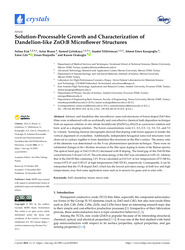
Intrinsic and dandelion-like microflower nano-rod structures of boron-doped ZnO thin
films were synthesized with an ecofriendly and cost-effective chemical bath deposition technique
from an aqueous solution of zinc nitrate hexahdyrate [Zn(NO3)2.6H2O] as a precursor solution and
boric acid as a doping solution. The boron concentrations were 0.1, 0.3, 0.5, 1.0, 3.0, 5.0, and 7.0
by volume. Scanning electron micrographs showed that doping with boron appears to hinder the
vertical alignment of crystallites. Additionally, independent hexagonal nano-rod structures were
observed to coalesce together to form dandelion-like structures on the film’s surface. The atomic ratio
of the elements was determined via the X-ray photoemission spectrum technique. There were no
substantial changes in the vibration structure of the film upon doping in terms of the Raman spectra.
The optical band gap of ZnO (3.28 eV) decreased with B doping. The band gap of the ZnO:B film
varied between 3.18 and 3.22 eV. The activation energy of the ZnO was calculated as 0.051 eV, whereas
that of the ZnO:B film containing 1.0% B was calculated as 0.013 eV at low temperatures (273–348 K),
versus 0.072 eV and 0.183 eV at high temperatures (348–523 K), respectively. Consequently, it can be
interpreted that the 1% B-doped ZnO, which has the lowest activation energy at both low and high
temperatures, may find some application areas such as in sensors for gases and in solar cells.
- Enstitüler
- Fen Bilimleri Enstitüsü
- Nanoteknoloji ve İleri Malzemeler Anabilim Dalı
|
Eser Adı dc.title |
Solution-Processable Growth and Characterization of Dandelion-like ZnO:B Microflower Structures |
|---|---|
|
Yazarlar dc.contributor.author |
Yıldırımcan, Saadet |
|
Yazarlar dc.contributor.author |
Erat, Selma |
|
Yazarlar dc.contributor.author |
Çetinkaya, Samed |
|
Kurum Dışı Yazarlar dc.contributor.other |
Braun, Artur |
|
Kurum Dışı Yazarlar dc.contributor.other |
GÜR, EMRE |
|
Kurum Dışı Yazarlar dc.contributor.other |
Kasapoğlu, Ahmet Emre |
|
Kurum Dışı Yazarlar dc.contributor.other |
Ocakoğlu, Kasım |
|
Kurum Dışı Yazarlar dc.contributor.other |
Harputlu, Ersan |
|
Yayıncı dc.publisher |
Crystals |
|
Yayın Türü dc.type |
Makale |
|
Özet dc.description.abstract |
Intrinsic and dandelion-like microflower nano-rod structures of boron-doped ZnO thin films were synthesized with an ecofriendly and cost-effective chemical bath deposition technique from an aqueous solution of zinc nitrate hexahdyrate [Zn(NO3)2.6H2O] as a precursor solution and boric acid as a doping solution. The boron concentrations were 0.1, 0.3, 0.5, 1.0, 3.0, 5.0, and 7.0 by volume. Scanning electron micrographs showed that doping with boron appears to hinder the vertical alignment of crystallites. Additionally, independent hexagonal nano-rod structures were observed to coalesce together to form dandelion-like structures on the film’s surface. The atomic ratio of the elements was determined via the X-ray photoemission spectrum technique. There were no substantial changes in the vibration structure of the film upon doping in terms of the Raman spectra. The optical band gap of ZnO (3.28 eV) decreased with B doping. The band gap of the ZnO:B film varied between 3.18 and 3.22 eV. The activation energy of the ZnO was calculated as 0.051 eV, whereas that of the ZnO:B film containing 1.0% B was calculated as 0.013 eV at low temperatures (273–348 K), versus 0.072 eV and 0.183 eV at high temperatures (348–523 K), respectively. Consequently, it can be interpreted that the 1% B-doped ZnO, which has the lowest activation energy at both low and high temperatures, may find some application areas such as in sensors for gases and in solar cells. |
|
Kayıt Giriş Tarihi dc.date.accessioned |
2026-04-02 |
|
Yayın Yılı dc.date.issued |
2021 |
|
Açık Erișim Tarihi dc.date.available |
2026-04-02 |
|
Dil dc.language.iso |
eng |
|
Konu Başlıkları dc.subject |
Nanomalzemeler |
|
Konu Başlıkları dc.subject |
İnce film |
|
Konu Başlıkları dc.subject |
Kristal yapı |
|
Atıf İçin Künye dc.identifier.citation |
Solution-Processable Growth and Characterization of Dandelion-like ZnO:B Microflower Structures Selma Erat, Artur Braun, Samed Çetinkaya, Saadet Yildirimcan, Ahmet Emre Kasapoğlu, Emre Gür, Ersan Harputlu and Kasım Ocakoglu |
|
Haklar dc.rights |
Crystals |
|
ISSN dc.identifier.issn |
2073-4352 |
|
İlk Sayfa dc.identifier.startpage |
1 |
|
Son Sayfa dc.identifier.endpage |
21 |
|
Makale Numarası dc.identifier.articlenumber |
1 |
|
Dergi Adı dc.relation.journal |
Crystals |
|
Dergi Sayısı dc.identifier.issue |
11 |
|
Dergi Cilt dc.identifier.volume |
12 |
|
Tek Biçim Adres (URI) dc.identifier.uri |
https://hdl.handle.net/20.500.14114/10062 |
|
DOI Numarası dc.identifier.doi |
https://doi.org/10.3390/ cryst12010011 |
|
İndekslenen Platformlar dc.source.database |
MDPI |
-
PDF