




-
Arab World English Journal1
-
Dil Artaştırmaları Dergisi1
-
Dilbilim Araştırmaları Dergisi1
-
Journal of Academic Language and Literature1
-
Journal of Language Education and Research1
-
Journal of Language Education and Research (JLERE)1
-
Journal of Pragmatics1
-
Mersin Üniversitesi Dil ve Edebiyat Dergisi1
-
Metaphor and Symbol1
-
Metaphor ans Symbol1

PROFILING NEAR-SYNONYMY: A CORPUS-DRIVEN ANALYSIS OF THE TURKISH ADJECTIVES BÜYÜK, İRİ, AND KOCA
Muhammet Fatih Adıgüzel
2026-01-06
A Cross-Lingual Study on Near-synonyms Deep and Profound in English and Profond in French: Implications for Foreign Language Education
Muhammet Fatih Adıgüzel | Muzaffer Pınar Babanoğlu
This corpus-based study investigates the cross-linguistic and intra-linguistic relationships among the English near-synonyms "deep" and "profound," and the French word "profond." By analyzing the collocative behaviors of these adjectives, the study aims to identify the contexts in which "deep" and "profound" are interchangeable and whether "profound" in English and "profond" in French are semanically and ollocatively equivalent. Collocations were extracted from the English corpus "50% Sample of ukWaC" and the French corpus "Europarl 3: French." The analysis revealed both cross-linguistic and intra-linguistic similarities and differences. Intra-linguistic similarities and differences were observed between "deep" and "profound" in English, while cross-linguistic comparisons were made between...
Corpus-driven Lexical Profiles of the Turkish Synonym Set Sadece, Yalnızca and Yalnız
Muhammet Fatih Adıgüzel
This is a corpus-driven study based on the TNCv3.0 to identify lexical profiles of the synonym set of Turkish exclusive adverbials sadece, yalnızca and yalnız within the framework of the Model of Extended Lexical Units (Stubbs, 2002). From the concordances of the adverbials, their context dependent semantic, pragmatic and syntactic properties, co-occurrence tendencies, and synonymity levels were identified. It was found that sadece and yalnızca have a high contextual and collocational equinormality and are completely intersubstitutable and complete synonyms (Lyons, 1981) with yalnızca used less frequently. Yalnız is polysemous and multifunctional and has a sense synonymy relation with the others only when it means only. Even in the sense of only, yalnız was found to be rarely used in cer...

Exploring the Turkish Concept İrkil-: Corpus-driven Cognitive and Lexical Profiling of a Pre-emotion
Muhammet Fatih Adıgüzel | Yeşim Aksan
As a multi-disciplinary study about irkil- (get startled), which combines findings from psychology, cognitive and corpus linguistics, the article aims to identify the lexical profile and cognitive structure of this pre-emotion through its concordances from the TNC. We employed model of extended lexical units, which involves identifying irkil’s typical collocates, colligates, semantic preferences and discourse prosodies. As part of its event schema, irkil- was found to have a linguistic schema to be filled by certain paradigmatic and syntagmatic choices. We found typical collocates of irkil- are determined by the experiencer’s pre-startle situation (engrossment/absence), sudden stimuli of acoustic, tactile, visual and cognitive natures, post-startle behavioural tendencies characterised by...
Conceptual Blending Theory: The Case of ‘Flying Bus’ from Turkish
Muhammet Fatih Adıgüzel
Theory (CIT) and Conceptual metaphor Theory (CMT), this study investigates the application of Conceptual Blending Theory to a Turkish scenario where a Turkish speaker conceptualises a dangerously speeding bus as flying and associates it with Turkish Airlines. The study emphasizes the role of conceptual blending in creating novel meanings online by integrating disparate conceptual elements, as well as highlighting the complementary nature of CIT and CMT in meaning construction. In our scenario, the speaker’s metaphoric utterance as a reaction to the overspeed of a bus was explained by the metaphor TOO FAST DRIVING IS FLYING, which inherits the superordinate metaphor FAST MOTION IS FLIGHT, which is entrenched in our cultural cognition. Through a conceptual blending ne...
Cultural surreal hybrid creatures in idioms: From blended concepts to metaphorical source domains
Muhammet Fatih Adıgüzel
This chapter investigates the role of cultural surreal hybrid creatures in idiomatic expressions, bridging Conceptual Blending Theory (Fauconnier & Turner) and Conceptual Metaphor Theory (Lakoff & Johnson). Many idioms draw on fantastical, culturally specific hybrid beings—such as half-human/half-animal or monstrous composites—that originate as blended conceptual structures in the mind. These blends integrate input spaces (e.g., human traits, animal behaviors, mythical elements) to create emergent meanings that cannot be reduced to their literal components. The analysis focuses on Turkish idioms featuring such entities (e.g., involving dragons, centaurs-like figures, or folkloric monsters), demonstrating how surreal hybrids function as powerful metaphorical source domains for abstract conc...
A Corpus-Driven Study on the Turkish Focus Particle Sırf
Muhammet Fatih Adıgüzel
This is a corpus-driven study based on the TNCv3.0 to determine the co-occurrence patterns of the focus particle sırf (only/just) in its scopes. The study revealed that sırf’s syntactic associates are largely phrases or clauses of purpose or reason. Over half of the 430 concordance lines analysed had various purpose or reason expressions as sırf’s focused constitutes. The most frequent colligates in the exclusive operator’s scopes are reason and purpose markers diye or için, ranking the first two in its collocation list. This very strong lexical priming suggests a pragmatic motivation. By choosing sırf rather than any other particles like sadece or yalnızca, the speaker not only marks the single reason or purpose for which something is done but also often reflects a negative attitude to ...

SEMANTIC AND PRAGMATIC ANALYSIS OF THE TURKISH DISCOURSE PARTICLE HELE: A CORPUS-DRIVEN STUDY IN LEXICAL PROFILING
Muhammet Fatih Adıgüzel
The present study investigates the Turkish discourse particle hele, commonly used especially in spoken Turkish, in terms of its semantic and pragmatic uses in naturally occurring language. All analyses are based on attested data obtained from Turkish National Corpus (demo version). This corpus-driven study is thus naturally a product of an inductive undertaking. First, the common senses and corpus-driven pragmatic functions of the discourse particle hele are determined and further analyzes are carried out to derive its lexical profile from a variety of contexts of use. To this end, hele’s common collocation patterns hele o, hele şu, hele bir and hele bir de are analyzed in their contexts and then basic observations on its colligations, semantic preference and semantic p...

Analysis of the Pragmatic Functions of the Turkish Discourse Markers Halbuki and Oysa (Ki)
Muhammet Fatih Adıgüzel
This study investigates the pragmatic functions of the Turkish discourse markers halbuki and oysa (ki), which are commonly associated with contrastive relations in discourse. Adopting a corpus-based approach, the study argues that these forms function not only as contrastive connectors but also as multifunctional discourse markers that encode speaker stance, expectation violation, and inferential guidance. Through an analysis of their distribution, positional patterns, and contextual uses, the study examines how halbuki and oysa (ki) contribute to discourse coherence and the organization of information structure. The findings demonstrate that both markers play a significant role in establishing presuppositions, structuring opposing viewpoints, and guiding the hearer’s interpretive processe...
TÜRKÇE KORKU DEYİMLERİNDE METAFOR VE METONİMİ İZLERİ
Muhammet Fatih Adıgüzel | Yeşim Aksan
Makalede Türkçedeki fizyolojik temelli ve kültürel senaryo ürünü korku deyimlerinin ardında yatan kavramsal metaforlar, metonimiler ve imge şemaları tartışılmıştır. Deyimlerin anlamlarının nedensiz olmadığı, metafor, metonimi ve imge şemaları gibi bilişsel mekanizmaların etkisinde yaratıldıkları savunulmuştur. Özellikle korkuyu gerçek dışı kültürel senaryolarla kavramlaştıran deyimlerin incelenmesi sonucu korkunun beden parçalarına ve organlarına hasar veren yıkıcı bir güç olarak kavramlaştırıldığı görülmüştür. Çalışmada korku duygusunun deneyimlenmesini Türk kültürüne özgü olarak yansıtan 14 deyim bilişsel dilbilim araçları açısından irdelenerek metafor ve metonimi profilleri çıkarılmıştır.
The functional spectrum of the Turkish pragmatic marker Ya
Muhammet Fatih Adıgüzel
The corpus-driven studyexplores the functional spectrum of the Turkish pragmatic marker ya. Including functional, syntactic and collocational discussions, it reveals that ya often functions in the interpersonal domain, reflecting the speaker's usually negative affective stance. The study indicates that ya acts as a reminder of shared knowledge to avoid communication glitches. In the textual/sequential domain, ya is used as a topic initiator, shifter and expander. Its longer form, yaa has an idiosyncratic summative function, signalling topic termination after the speaker has satisfactorily enlightened an issue. At the utterance-medial position, ya marks the preceding segment as a reason clause, often reflecting unfavourable attitudes. In appeal intonation, ya sounds like a marker of ha...

KAVRAMSAL HARMANLAMA KURAMI ÜZERINE NOTLAR VE ÖRNEKLER
Muhammet Fatih Adıgüzel
Bu çalışma, Bilişsel Dilbilim alanında Fauconnier ve Turner tarafından geliştirilen ve anlamın zihinsel inşasını dinamik bir süreç olarak ele alan Kavramsal Harmanlama Kuramı’nı (Conceptual Blending Theory) incelemektedir. Çalışmanın temel amacı, ağırlıklı olarak İngilizce kaynakların bulunduğu bu alanda Türkçe terminoloji önerileri sunarak kuramsal bir çerçeve çizmektir. Çalışmada, Kavramsal Metafor Kuramı’ndan farklı olarak, harmanlama işleminin en az dört zihinsel alandan (girdi alanları, genel alan ve harmanlama alanı) oluşan ağ yapısı ve bu süreçte ortaya çıkan “türemiş yapı” (emergent structure) kavramı detaylandırılmıştır. Kuramsal temellerin somutlaştırılması amacıyla, alanyazında sıkça tartışılan “Bu cerrah bir kasaptır” ve “Öfkeden kulaklarından duman çıkmak” örnekleri, zihinsel ...
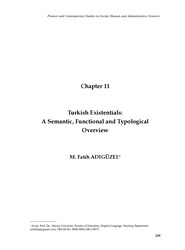
Turkish Existentials: A Semantic, Functional and Typological Overview
Muhammet Fatih Adıgüzel
The purpose of the study is to discuss basic issues concerning the existential constructions in Turkish both morpho-syntactically and semantically as well as referring to any pragmatic concerns involved in the selection of an existential form. The study is not only a descriptive study that deals with issues about the basic existential predicates used in Turkish, namely var and yok, but also sheds light on other lexical items that express existence in Turkish such as the adjectival counterpart mevcut, and the verbal existential predicates bulun-, and dur-. With many examples over 50, it gives learners of Turkish as a foreign language and researchers interested in Turkish studies valuable insights into the semantic and structural properties of the Turkish existential oper...
CONTEXT-DEPENDENT EXISTENTIAL FUNCTION OF SÖZ KONUSU AND SEMANTIC PROPERTIES OF NOUNS IN ITS PIVOTS
Muhammet Fatih Adıgüzel
2026-01-06
EXPLORING THE NUANCES BETWEEN TWO POWERFUL SYNONYMS IN TURKISH: “KUŞKULAN-” AND “ŞÜPHELEN-”
Muhammet Fatih Adıgüzel
2026-01-06