

Efficient synthesis of functionalized 3-aryl-1,3-aminoalcohols
Nural, Yahya | Dondas, Haci Ali
2025-12-29
Synthesis and anti(myco)bacterial activity of novel 5,5-diphenylpyrrolidine N-aroylthiourea derivatives and a functionalized hexahydro-1H-pyrrolo[1,2-c]imidazole
Ersen, Duygu | Ulger, Mahmut | Gemili, Muge | Nural, Yahya
In this paper, five novel 5,5-diphenylpyrrolidine N-aroylthiourea derivatives were synthesized by stereoselective cycloaddition of N-diphenylmethylene-protected glycine methyl ester and methyl acrylate, and subsequent coupling with aroylisothiocyanates. The cis-stereochemistry of one of the heterocyclic thiourea derivatives was characterized by single crystal X-ray diffraction studies. The compounds showed antibacterial activity against Staphylococcus aureus, Bacillus subtilis, Aeromonas hydrophila, Escherichia. coli and Acinetobacter baumannii with minimum inhibitory concentration values in the range of 62.5-1000 mu g/mL against these bacterial strains. Antimycobacterial activity of the compounds was investigated against the M. tuberculosis H37Rv strain and all compounds exhibited antimyc...
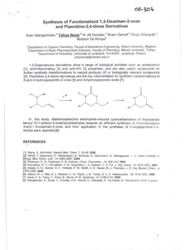
Synthesis of functionalized 1,3-oxazinan-2-ones and piperidine-2,4-dione derivatives
Nural, Yahya | Dondas, Haci Ali
1,3_oxazinanone derivatives show a range of biological activities such as antıbacterial [,1], anti-inflamm atory |2| and anti-HlV [3] properties, and are also usefuI compounds for further synthetic transformations to natura| products [4] or biologically relevant compounds [5]. Piperidine-2,4-dione derivatives are the key intermediates for synthetic transformations to 6-9ryl4-hydroxypiperidin-2-ones [6] and 4-hydroxypipecolic acids [7] ln this study, diastereoselective electrophile-induced cyclocarbamation of N_protected benzyl N-(1-pheny1-3-butenyl)carbamates towards an efficient synthesis o{ o-functiona|ized 4-aryl1,3-oxazinan-2-ones and their application in the synthesis of 6-arylpiperidine-2,4 _ diones were repoied [8].
Diastereoselective synthesis of 6-functionalized 4-aryl-1,3-oxazinan-2-ones and their application in the synthesis of 3-aryl-1,3-aminoalcohols and 6-arylpiperidine-2,4-diones
Nural, Yahya | Dondas, Haci Ali
Halocyclocarbamation of benzyl N-(1-phenyl-3-butenyl)carbamates afforded 6-functionalized 4-aryl-1,3-oxazinan-2-ones with moderate to excellent diastereoselectivity depending on the N-substituent. Importantly, in contrast to reported cyclocarbamations of homoallylic carbamates, which are generally trans-diastereoselective, cyclization of N-unsubstituted Cbz-protected homoallylamines led to cis-1,3-oxazinan-2-ones, predominantly. The use of N-benzylated and in situ prepared N-silylated derivatives resulted however in trans-selectivity. Transition states are proposed to explain the stereochemical influence of the N-substituent on the cyclocarbamations. The functionalized 1,3-oxazinan-2-ones could be further elaborated towards biologically or synthetically important 6-arylpiperidine-2,4-dione...
Synthesis of γ,δ-Aziridino α-Amino Acid Derivatives and their Stereoselective Ring Transformation to 2-(Aminomethyl)-1-aminocyclopropanecarboxylic Acid Derivatives
Nural, Yahya
1-Benzyl-2-(bromomethyl)aziridine was successfully substituted with protected glycine esters to afford alkyl 3-(N-benzylaziridin-2-yl)-2-aminopropanoates, as constrained heterocyclic diamino acid derivatives, in good isolated yields. These new aziridines proved to be excellent building blocks for ring transformation to the corresponding stereochemically defined 2-(aminomethyl)-1-aminocyclopropanecarboxylic acid derivatives, including methyl esters, piperidyl amides, and free carboxylic acids.