





Effects of Fenbutatin Oxide on Antioxidant System of Different Tissues in Cyprinus Carpio (L., 1758)
YILMAZ, FERBAL ÖZKAN | HUNT, ARZU ÖZLÜER | YALIN, SERAP
In this study, effects of sublethal concentrations of fenbutatin oxide on catalase (CAT) and superoxide dismutase (SOD) activities and lipid peroxidation in muscle, liver, kidney and brain tissues of Cyprinus carpio were investigated. The 96-hours LC50 value for fenbutatin oxide was determined as 1.544 mg/L for C. carpio in this study. 0.15 mg/L (1/10 of LC50) and 0.30 mg/L (1/5 of LC50) sublethal concentrations were applied for 96 h (4 days) in this experiment. The CAT activities in tissues were increased relation to doses applied. The SOD activities were decreased by 0.30 mg/L. The tissue MDA levels were significantly increased in relation to dose applied.
Influence of Sublethal Chlorpyrifos Exposure on Oxıdative Stress and Acetylcholinesterase Activity in Common Carp (Cyprinus carpio)
YILMAZ, FERBAL ÖZKAN | HUNT, ARZU ÖZLÜER | YALIN, SERAP
The commonly used pesticides in agriculture cause enzyme inactivation and DNA damage via reacting with macromolecules and may also initiate peroxidation of poly-unsaturated fatty acids (PUFA) by generating of the reactive oxygen species (ROS), as a consequence they can lead to the oxidative stress. The objective of this study was to determine the oxidative and neurotoxic potential of sublethal chlorpyrifos in the brain tissue of Cyprinus carpio (C. carpio) for a period of 96 and 240 hours, respectively. Therefore, the levels of malondialdehyde (MDA), glutathione (GSH), advanced oxidation protein products (AOPP), protein carbonyl, and 8-hydroxydeoxyguanosine (8-OHdG) levels and activities of superoxide dismutase (SOD), catalase, glutathione peroxidase (GSH-Px) and acetylcholinesterase (AChE...
Incidence of inducible bacteriophage in Bacillus sp. And Pseudomonas sp. Strains isolated from contaminated soil in Mersin
Coral, Mutlu Nisa Ünaldı
In the current study, the effects of environmental agents on induction of soil lysogenic bacteria were studied. To estimate the prevalence of lysogeny within bacterial communities from contaminated soil, induction assays were carried out by extracting bacteria from soil. A series of experiments were conducted with samples collected in Mersin to assess the impact of some physical and chemical agents on propage induction in natural populations. A total of 90 bacteria were isolated from these sites. UV radiation, temperature, some mutagens and hydrocarbons were used to induce prophage in lysogenic bacteria. Two-thirds of the lysogenic bacteria showed prophage induction by one of the agents. The effects of these agents on the efficiency of plating (EOP) and on the adsorption of lytic bacteriop...
MicroRNAs Expression Profiles in Non-Small Cell Lung Cancer
Yaroğlu, Hatice Yıldırım | Balcı, Şenay | Tamer, Lülüfer | Ayan, Erhan | Ünal, Zeynep Nil
MicroRNAs (miRNAs) are a new endogenous small non-coding RNA family that arranges expression of a few genes related in normal development as well as human diseases such as cancer. miRNAs are developing as potential diagnostic and therapeutic markers with deregulated expression in various cancers including lung cancer. In this study, we aimed to find out miRNA expression profiles and to show the relationship between non-small cell lung cancer and microRNAs levels, if there is. In the present study, the expression profiles of 740 miRNA in plasma from 31 patients and 64 healthy subjects were evaluated using high-throughput real-time quantitative polymerase chain reaction. All statistical analyses were performed using the Biogazelle's qbase PLUS 2.0 software. Our results showed that expression...
Detection of polycyclic aromatic hydrocarbon (PAH) degradation genes in polluted soil by DNA extraction and colony hybridization
Coral, Gökhan | Coral, Mutlu Nisa Ünaldı
The aim of this study is to detect the DNA sequences for the PAH-dioxygenase gene, the key enzyme of the aeго-bic catabolic for polycyclic aromatic hydrocarbon degra-dation, in soil microorganisms by using extraction of total DNA, PCR amplification PAH-dioxygenase sequences, and detection with colony hybridization. To determine whether bacteria containing PAH-dioxygenase gene actually exist in environments contaminated by crude oil or not, the ge-nomic DNA was purified using a genomic DNA purifica-tion kit. Purified genomic DNA was then amplified with a thermal cycler, and the PCR products were separeted by agarose gel electrophoresis. Pseudomonas sp. strain ARP 26, which is capable of degrading phenanthrene, was used as target for colony hybridization. It was confirmed that Pseudomonas sp...
Effects of medium concentration and exposure period on the mercury accumulation in tissues of Cyprinus carpio (L.1758)
Mustafa Kalay, Ahmet Erdem Dönmez, Cafer Erkin Koyuncu
Mercury accumulation in different tissues of Cyprinus carpio was measured after exposing the fish to 25 and 50 ppb mercury for 15 and 30 days. At the end of experiments, gill, liver, spleen and brain tissues of fish were dissected separately. Dissected tissue samples were prepared with wet digestion for mercury analysis. Mercury concentration of samples was determined by cold vapor atomic absorption spectrophotometry. For all the tissues analyzed, mercury accumulation level displayed an increase, depending on the medium mercury content and exposure period. When compared to the other tissues, a more evident increase was reported in the mercury level of spleen tissue, especially in the 50 ppb medium mercury content. Among all the tissues analyzed, mercury level in the liver tissue is the low...
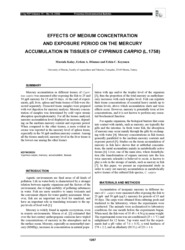
Effects of Medium Concentration and Exposure Period on the Mercury Accumulation in Tissues of Cyrinus carpio L 1758
Ahmet Erdem Dönmez, Cafer Erkin Koyuncu
Mercury accumulation in different tissues of Cyprinus carpio was measured after exposing the fish to 25 and 50 ppb mercury for 15 and 30 days. At the end ofexperiments, gill, liver, spleen and brain tissues of fish were dissected separately. Dissected tissue samples were prepared with wet digestion for mercury analysis. Mercury concentration of samples was determined by cold vapor atomic absorption spectrophotometry. For all the tissues analyzed, mercury accumulation level displayed an increase, depending on the medium mercury content and exposure period. When compared to the other tissues, a more evident increase was reported in the mercury level of spleen tissue, especially in the 50 ppb medium mercury content. Among all the tissues analyzed, mercury level in the liver tissue is the low...

Accumulation of Chromium in Hepatopancreas Gill and Muscle Tissues of Callinectes sapidus
Çiftçi, Nuray | Cicik, Bedii | Ay, Özcan | Karayakar, Fahri | Karaytuğ, Sahire
Accumulation of chromium (VI) in hepatopancreas, gill and muscle tissues of Callinectes sapidus was studied after exposing the animals to 1.0, 2.0 and 4.0 ppm chromium (IV) over 96 hours. Tissue levels of the metal were determined using Atomic Absorbtion Spectrophotometric (AAS) methods. No mortality was observed in any concentration of chromium after 96 hours of exposure. Accumulation of chromium in hepatopancreas and gill tissues increased with increasing concentrations of the metal, whereas muscle accumulation was below detection limits of AAS at the concentrations tested. The following relationship was found among the tissues in accumulating chromium; Gill > Hepatopancreas > Muscle
EFFECTS OF COPPER AND LEAD ON SOME HEMATOLOGICAL PARAMETERS OF Oreochromis niloticus
Çiftçi, Nuray | Karayakar, Fahri | Ay, Özcan | Cicik, Bedii
Effects of sub-lethal concentrations of copper and lead on hematocrit and mean cell volume (MCV) levels and on erythrocyte numbers, erythrocyte and erythrocyte nucleus areas were determined after exposing Oreochromis niloticus to 4 ppm Cu and 0.2 ppm Pb over 7, 15 and 30 days. Micro-hematocrit methods were adopted in determining hematocrit levels and microscopic methods were used to determine MCV, erythrocyte numbers, erythrocyte and erythrocyte nucleus areas. Hematocrit and MCV levels and erythrocyte and nucleus areas increased significantly (P
Investıgatıon of the possıble role of Poly (Adp-Rıbose) polymerase pathway in Nıcotıne- Exposed Testıcular Damage
Hazır, Selin | Yaroğlu, Hatice Yıldırım | Bayram, Gül | Aşkın, Ali
Although known adverse effects of nicotine exposure on general health, it is largely consumed as cigarette smoking. Smoking has negative effects on the fertility in males; however, the molecular mechanisms affected by nicotine are largely unclear. In this study, we aimed to investigate the effect of nicotine on poly(ADP-ribose) polymerase (PARP) pathway in testicular damage. Twenty-four male C57BL/6J mice were arbitrarily categorized into three subgroups: control, sham (subcutaneous, 0.9% sterile saline), and nicotine (subcutaneous, 3 mg/kg/body weight/day) groups. After 14 days of twice-daily subcutaneous injections, the weights of the body and testes were measured. The levels of testosterone, follicle-stimulating hormone (FSH), luteinizing hormone (LH), cotinine (main metabolite of nicot...
EFFECTS OF ZINC AND CADMIUM ON CONDITION FACTOR, HEPATOSOMATIC AND GONADOSOMATIC INDEX OF Oreochromis niloticus
Çiftçi, Nuray | Ay, Özcan | Karayakar, Fahri | Cicik, Bedii
Effects of Zn and Cd on condition factor (CF), hepatosomatic (HIS) and gonadosomatic (GSI) of Oreochromis niloticus, after exposing the animals to 10 % of their LC50 values, namely 6.0 ppm Zn and 1.6 ppm Cd, over 7, 15, and 30 days. Standard mathematical formulations were used in determining the mentioned parameters. Cadmium, which is a toxic metal, increased GSI and decreased HSI and CF at the beginning of the experiments. The decrease in HSI and CF continued with increasing exposure periods. Zinc, however, decreased all three parameters compared with control at the end of experiments (P
Heavy metal levels in five species of fish caught from Mersin Gulf.
Karayakar, Fahri | Karaytug, Sahire | Cicik, Bedii | Ay, Özcan | Ciftci, Nuray
The aim of the present study was to determine the levels of cadmium, copper, zinc and chromium in the liver, gill and muscle tissues of some pelagic, benthopelagic and benthic fish species caught from Mersin Gulf and sold at Karaduvar Harbor. Pelagic species Sardinella aurita (Clupeidae), Liza ramado (Mugilidae), benthopelagic species Diplodus annularis (Sparidae) and benthic species Solea lutea (Soleidae) and Umbrina cirrosa (Sciaenidae) were selected as the study material. Atomic absorption spectrophotometric methods were applied in determining the tissue levels of metals. Metal levels showed tissue-dependent changes in the species studied. Pb and Cr levels were below detection limit; hence no comparison was made among the tissues. Cd, Cu and Zn levels were highest in the liver tissues a...

Metal levels of macroalgae from Iskenderun and Mersin Bay Turkey eastern Mediterranean
Çiftçi, Nuray | AYAS, Deniz
This study aimed to determine metals' concentrations (Cr, Se, Fe, Cu, Zn, Cd, V, As, Sr, Pb) in macroalgae species sampled from Iskenderun and Mersin Bay between June-October 2018, and these samples were from the depths of 0 to 2 meters. Inductively coupled plasma mass spectrometer (ICP-MS) technique was used for metal analysis. Differences in the metal levels were analyzed using the ANOVA method. Metal concentrations of samples were found as Fe> Sr> Zn> Cr> Cu> V> Se ≥ As> Pb> Cd and Fe> Sr> Zn> Cr> Pb≥ Cu> V> Se> As> Cd from Iskenderun Bay and Mersin Bay, respectively (p
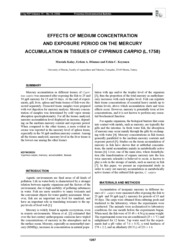
Effects of Medium Concentration and Exposure Period on the Mercury Accumulation in Tissues of Cyrinus carpio L 1758
Mustafa Kalay, Ahmet Erdem Dönmez, Cafer Erkin Koyuncu
Mercury accumulation in different tissues of Cyprinus carpio was measured after exposing the fish to 25 and 50 ppb mercury for 15 and 30 days. At the end of experiments, gill, liver, spleen and brain tissues of fish were dissected separately. Dissected tissue samples were prepared with wet digestion for mercury analysis. Mercury concentration of samples was determined by cold vapor atomic absorption spectrophotometry. For all the tissues analyzed, mercury accumulation level displayed an increase, depending on the medium mercury content and exposure period. When compared to the other tissues, a more evident increase was reported in the mercury level of spleen tissue, especially in the 50 ppb medium mercury content. Among all the tissues analyzed, mercury level in the liver tissue is the l...